Escape Artist
  • Features
    • Interview
    • Expat News
    • Field Notes
    • Trending
  • Your Plan B
    • Finance
    • Real Estate
    • Second Citizenship
    • Digital Nomad
    • Healthcare
  • Destinations
    • Europe
      • France
      • Germany
      • Italy
      • Portugal
      • Scandinavia
      • Spain
      • United Kingdom
      • Rest of Europe
    • Central America
      • Belize
      • Costa Rica
      • El Salvador
      • Guatemala
      • Honduras
      • Nicaragua
      • Panama
    • Others
      • Africa
      • Asia
      • Australia
      • North America
      • South America
      • Middle East
      • Rest of the World
  • Travel Tips
    • Know Before You Go
    • Packing List
    • Food + Culture
    • Health + Wellness
  • Subscribe
Escape Artist
  • Features
    • Interview
    • Expat News
    • Field Notes
    • Trending
  • Your Plan B
    • Finance
    • Real Estate
    • Second Citizenship
    • Digital Nomad
    • Healthcare
  • Destinations
    • Europe
      • France
      • Germany
      • Italy
      • Portugal
      • Scandinavia
      • Spain
      • United Kingdom
      • Rest of Europe
    • Central America
      • Belize
      • Costa Rica
      • El Salvador
      • Guatemala
      • Honduras
      • Nicaragua
      • Panama
    • Others
      • Africa
      • Asia
      • Australia
      • North America
      • South America
      • Middle East
      • Rest of the World
  • Travel Tips
    • Know Before You Go
    • Packing List
    • Food + Culture
    • Health + Wellness
  • Subscribe
👤

THE NUMBER ONE SOURCE FOR BUILDING A LIFE ABROAD

This field is for validation purposes and should be left unchanged.
  • Italy

79 A.D., Pompeii Italy

  • BY Rachel Jensen
  • August 12, 2017
Total
0
Shares
0
0
0

The year was 79 A.D. and Pompeii was a thriving Roman port city nearly seven centuries old when it was erased from the map after the devastating volcanic eruption of Mt. Vesuvius. An eruption so catastrophic it completely obliterated one of the most sophisticated cities of its time, leaving no signs of existence or life.  Littered with layers of ash and pumice (lapilli), this lost city was only rediscovered over a thousand years later in the late 1500s by Italian architect, Domenico Fontana, during the digging of a canal.

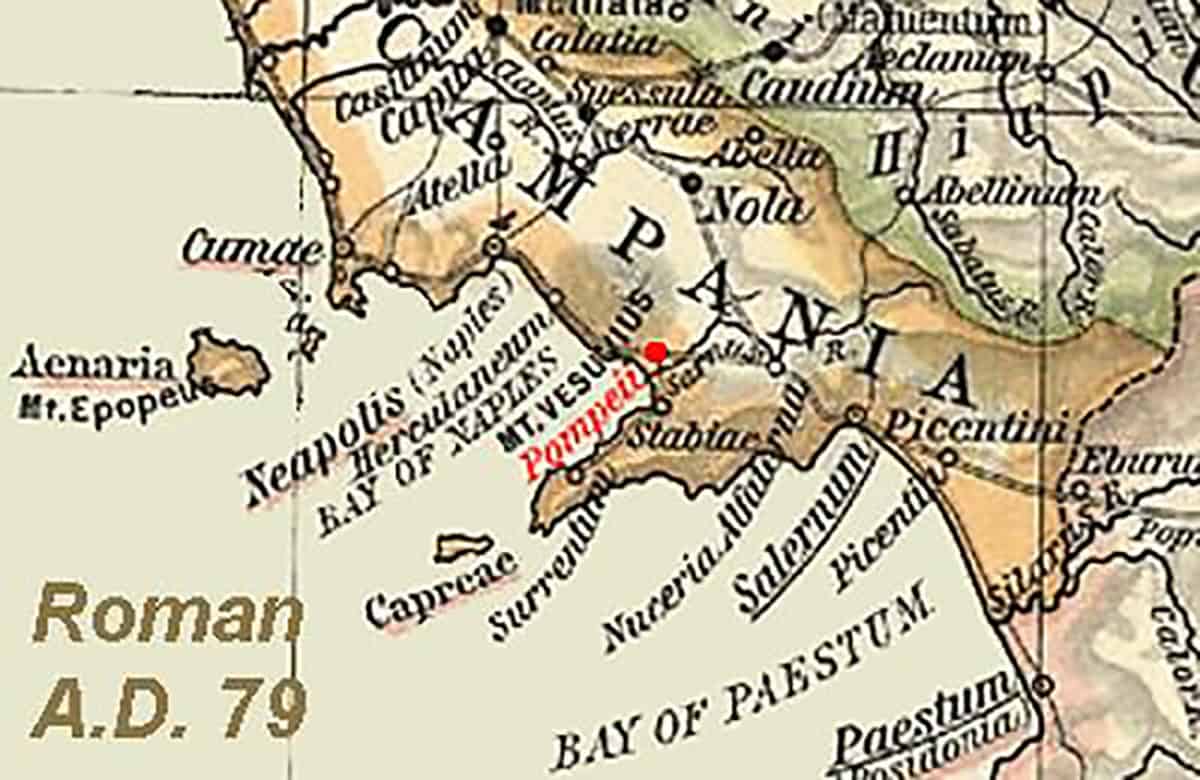
What’s absolutely fascinating about Pompeii is that due to the preservation from the lapilli and the slow, continuing excavations (which properly started in the mid 1700s), we’re able to piece together the culture, lifestyle, and infrastructure of a civilization that is nearly 2000 years old.    In addition, after the eruption in 79 A.D., the lapilli changed the geography of the land, creating a new shoreline, nearly 3 miles away from where Pompeii is today.  
#ThrowbackTuesday to 79 A.D., Pompeii Italy

Location of Pompeii pre-79 A.D. eruption indicated in red. Land mass post-eruption indicated by black border.

—

It was a balmy, humid August day on the western coast of Italy and my family decided to spend the morning exploring Pompeii. During the drive to the site we discussed what we have previously learned about this lost society.  We must’ve all been reading from the same high school social studies textbook, because all we could recite was that bodies of inhabitants were found in the position they were in when the volcano erupted. Boy, did we have a lot to learn…and we did just that with our Italian tour guide, Sabrina.

When we entered the walled city of Pompeii we literally took a step back in time, walking on the original road with stones that were laid over 2000 years ago.  Lining the streets were white stones, known as “cat’s’ eyes,” which were used as reflectors.  Drainage troughs on either side of the road collected rain water which led back to the sea.  And sidewalks, also with drainage, were raised to create easy access for the townspeople to get to and from the stores and their home.  (Heck, parts of the world today still don’t know what sidewalk draining is.)  In the middle of some streets were long, flat raised rocks, strategically placed so that carts could still pass, yet the people had a lily pad to hop on when crossing the street.

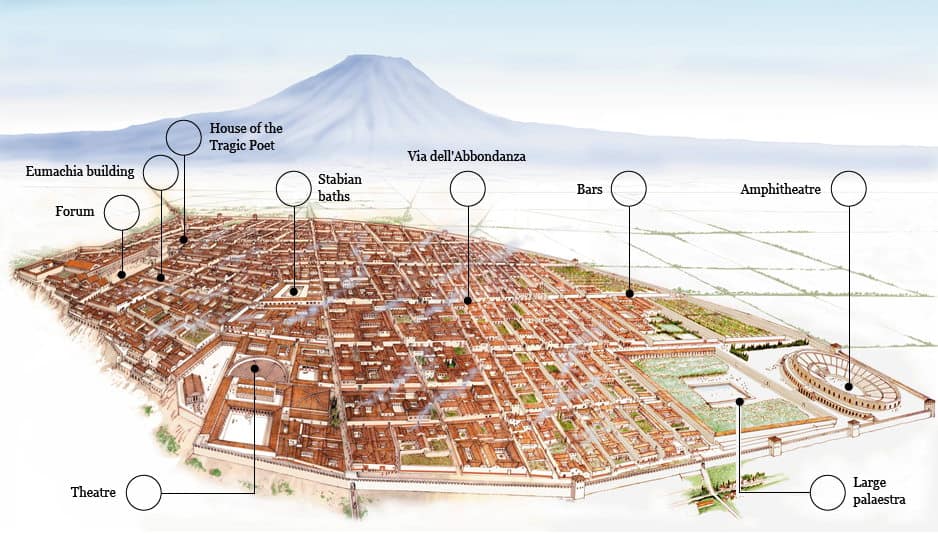
Home to nearly 20,000 citizens at its peak, this sophisticated port city was frequented by traders and businessmen due to the convenient location on the Mediterranean.  Enclosed in the 170-acre community was a theater, amphitheater, bars, fast-food shops, stores, plazas, hotel, and private residences.  Fast food shops were easily accessible from the road.  They weren’t called McDonalds back then, but the concept was the same, quick access to a meal.  
#ThrowbackTuesday to 79 A.D., Pompeii Italy

Stores lined the sidewalks with gates that slid across the ground from one end to the other, resulting in permanent grooves that are still visible today. Slaves typically lived above the shops and the primary residence of the business owner, if successful, lived behind the store.  Many homes also had an entrance from the street with a beautifully tiled foyer.  Inside the homes were running water, cisterns, guest rooms, staircases, lavish art, and gardens containing edible plants.  Life in Pompeii was advanced.  
#ThrowbackTuesday to 79 A.D., Pompeii Italy

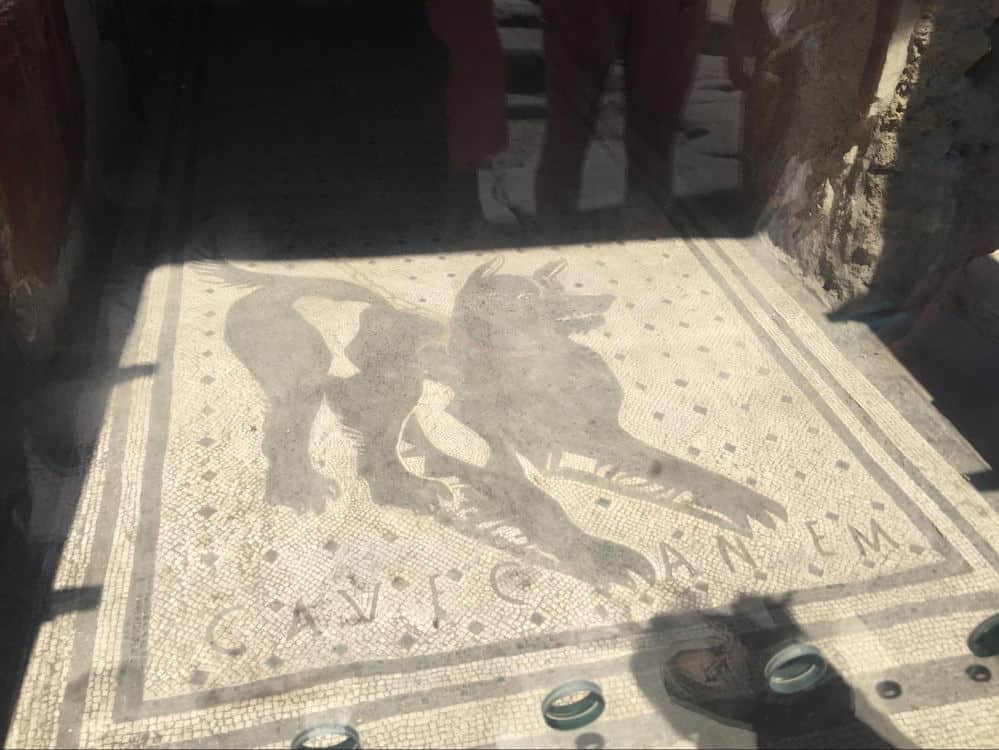
A mosaic entrance of a private residence saying “Cave Canem” in Latin, meaning “Beware of Dog.”

In addition, there was a spa. One for men and one for women.  It was a multi-tier building with fresco-painted walls and high ceilings lined by statues. There were a handful of rooms including a locker room, massage parlor, and sauna.  The sauna was specifically constructed to stay heated with pipes in the walls and under the floor pushing hot water through. Guests had to wear special wooden shoes when sauntering around to ensure their feet wouldn’t get burned.  In the back of the room was a marble tub full of cool water for guests to jump in when they needed to cool off.
As we walked through the old roads and listened to the different pieces of history from Sabrina, I was in awe about how advanced Pompeii was nearly 2 millenniums ago. 80% of the population was literate and the people had running water.  What’s astounding is that after Pompeii was lost, it seemed that infrastructure development throughout the world took a few steps backwards.  Sabrina says it was the shift from Paganism to Catholicism, with the new ruling power wanting to erase the past.  Others have different theories.

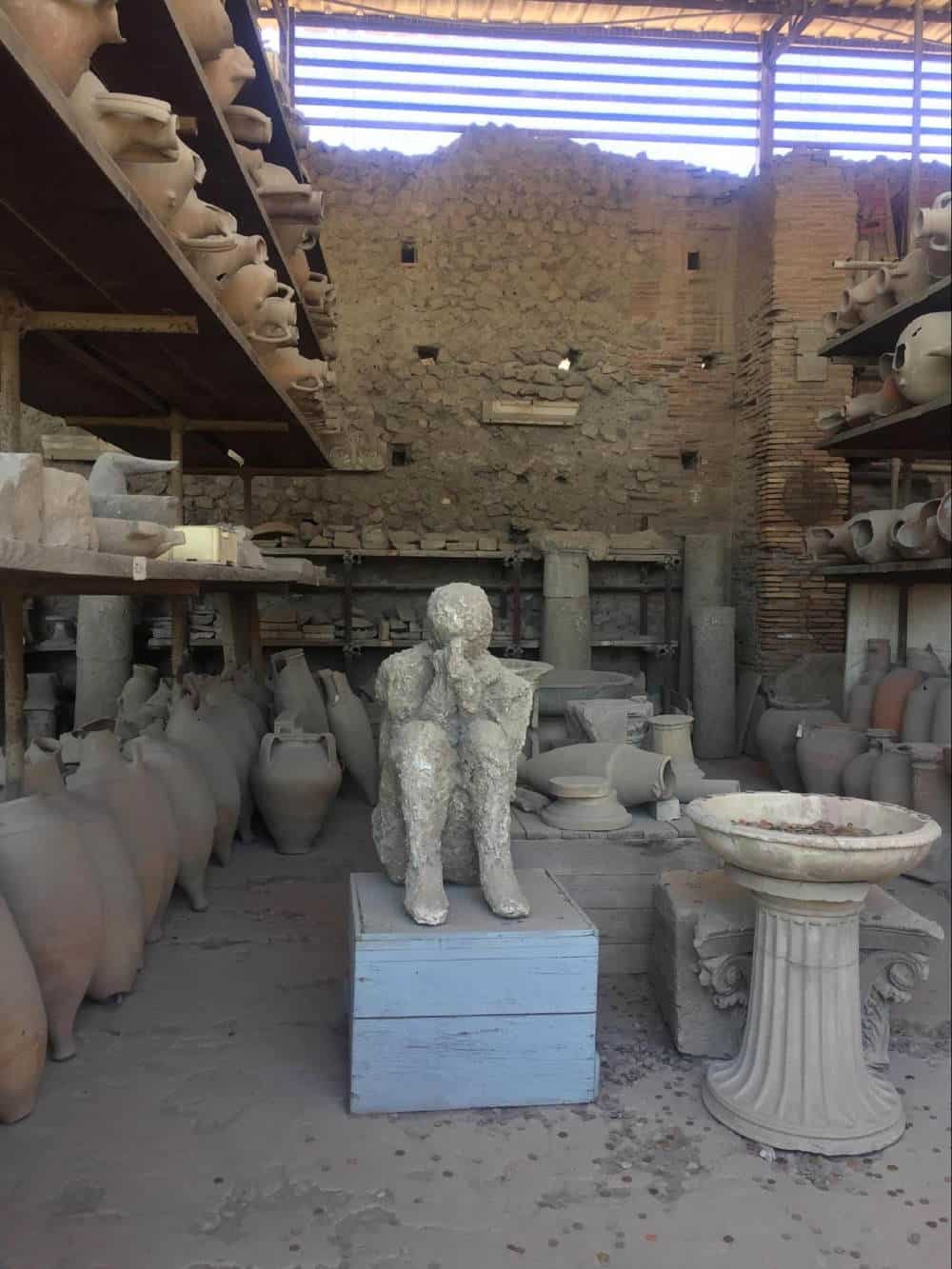
Due to an evacuation during a major earthquake in 62 A.D., the population in 79 A.D. was believed to be considerably lower at the time of the volcano, with only about 2,000. To date, less than 1,200 preserved bodies have been found still in the position they were in when the volcano erupted, and today are encased by plaster for better preservation.
#ThrowbackTuesday to 79 A.D., Pompeii Italy

A body from the 79 A.D. eruption preserved with a plaster shell.

Because excavations are still underway with roughly ¼ of the city remaining, many archeologists believe that additionalbodies will be found.  A few bodies can be seen on site with a majority of them in the Museo Archeologico Nazionale di Napoli.  Today the amphitheater is still in use.  Not for the traditional gladiator fights, but rather for concerts and shows.  Fun fact is that Pink Floyd filmed their concert movie in this space.

In just a few, short moments, an entire society was lost.  The remains of shops, entertainment, art, and developed infrastructure have, today, helped us to understand the flourishing city.  We have come a long way, and with excavations still in process, there is still much more to uncover.   
#ThrowbackTuesday to 79 A.D., Pompeii Italy

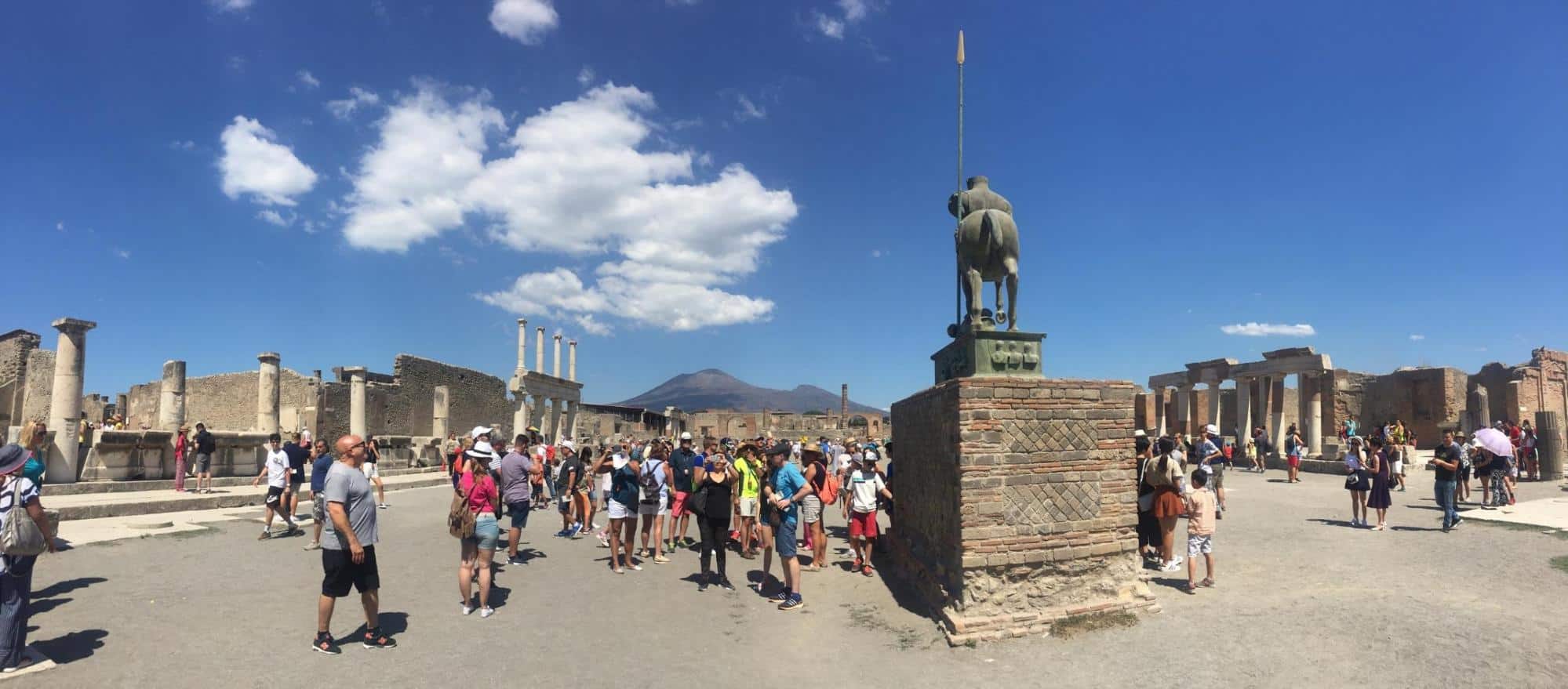
Pompeii’s forum.

Contact Author

"*" indicates required fields

This field is for validation purposes and should be left unchanged.
Name*
Please let us know what's on your mind. Have a question for us? Ask away.

Stay Ahead on Every Adventure! 

Stay updated with the World News on Escape Artist. Get all the travel news, international destinations, expat living, moving abroad, Lifestyle Tips, and digital nomad opportunities. Your next journey starts here—don’t miss a moment! Subscribe Now!

The year was 79 A.D. and Pompeii was a thriving Roman port city nearly seven centuries old when it was erased from the map after the devastating volcanic eruption of Mt. Vesuvius. An eruption so catastrophic it completely obliterated one of the most sophisticated cities of its time, leaving no signs of existence or life.  Littered with layers of ash and pumice (lapilli), this lost city was only rediscovered over a thousand years later in the late 1500s by Italian architect, Domenico Fontana, during the digging of a canal.

What’s absolutely fascinating about Pompeii is that due to the preservation from the lapilli and the slow, continuing excavations (which properly started in the mid 1700s), we’re able to piece together the culture, lifestyle, and infrastructure of a civilization that is nearly 2000 years old.    In addition, after the eruption in 79 A.D., the lapilli changed the geography of the land, creating a new shoreline, nearly 3 miles away from where Pompeii is today.  

Location of Pompeii pre-79 A.D. eruption indicated in red. Land mass post-eruption indicated by black border.

—

It was a balmy, humid August day on the western coast of Italy and my family decided to spend the morning exploring Pompeii. During the drive to the site we discussed what we have previously learned about this lost society.  We must’ve all been reading from the same high school social studies textbook, because all we could recite was that bodies of inhabitants were found in the position they were in when the volcano erupted. Boy, did we have a lot to learn…and we did just that with our Italian tour guide, Sabrina.

When we entered the walled city of Pompeii we literally took a step back in time, walking on the original road with stones that were laid over 2000 years ago.  Lining the streets were white stones, known as “cat’s’ eyes,” which were used as reflectors.  Drainage troughs on either side of the road collected rain water which led back to the sea.  And sidewalks, also with drainage, were raised to create easy access for the townspeople to get to and from the stores and their home.  (Heck, parts of the world today still don’t know what sidewalk draining is.)  In the middle of some streets were long, flat raised rocks, strategically placed so that carts could still pass, yet the people had a lily pad to hop on when crossing the street.

Home to nearly 20,000 citizens at its peak, this sophisticated port city was frequented by traders and businessmen due to the convenient location on the Mediterranean.  Enclosed in the 170-acre community was a theater, amphitheater, bars, fast-food shops, stores, plazas, hotel, and private residences.  Fast food shops were easily accessible from the road.  They weren’t called McDonalds back then, but the concept was the same, quick access to a meal.  

Stores lined the sidewalks with gates that slid across the ground from one end to the other, resulting in permanent grooves that are still visible today. Slaves typically lived above the shops and the primary residence of the business owner, if successful, lived behind the store.  Many homes also had an entrance from the street with a beautifully tiled foyer.  Inside the homes were running water, cisterns, guest rooms, staircases, lavish art, and gardens containing edible plants.  Life in Pompeii was advanced.  

A mosaic entrance of a private residence saying “Cave Canem” in Latin, meaning “Beware of Dog.”

In addition, there was a spa. One for men and one for women.  It was a multi-tier building with fresco-painted walls and high ceilings lined by statues. There were a handful of rooms including a locker room, massage parlor, and sauna.  The sauna was specifically constructed to stay heated with pipes in the walls and under the floor pushing hot water through. Guests had to wear special wooden shoes when sauntering around to ensure their feet wouldn’t get burned.  In the back of the room was a marble tub full of cool water for guests to jump in when they needed to cool off.

As we walked through the old roads and listened to the different pieces of history from Sabrina, I was in awe about how advanced Pompeii was nearly 2 millenniums ago. 80% of the population was literate and the people had running water.  What’s astounding is that after Pompeii was lost, it seemed that infrastructure development throughout the world took a few steps backwards.  Sabrina says it was the shift from Paganism to Catholicism, with the new ruling power wanting to erase the past.  Others have different theories.

Due to an evacuation during a major earthquake in 62 A.D., the population in 79 A.D. was believed to be considerably lower at the time of the volcano, with only about 2,000. To date, less than 1,200 preserved bodies have been found still in the position they were in when the volcano erupted, and today are encased by plaster for better preservation.

A body from the 79 A.D. eruption preserved with a plaster shell.

Because excavations are still underway with roughly ¼ of the city remaining, many archeologists believe that additionalbodies will be found.  A few bodies can be seen on site with a majority of them in the Museo Archeologico Nazionale di Napoli.  Today the amphitheater is still in use.  Not for the traditional gladiator fights, but rather for concerts and shows.  Fun fact is that Pink Floyd filmed their concert movie in this space.

In just a few, short moments, an entire society was lost.  The remains of shops, entertainment, art, and developed infrastructure have, today, helped us to understand the flourishing city.  We have come a long way, and with excavations still in process, there is still much more to uncover.   

Pompeii’s forum.

Contact Author

"*" indicates required fields

If you'd like to read the full story, simply enter your email to subscribe to our newsletter.

For even more expert insights, unmissable resources, and exclusive invites, explore our premium subscription offers here.

This field is for validation purposes and should be left unchanged.


OR

Subscribe Now

Already a Subscriber? Click here to login

Subscription required

You've reached your limit of free articles. For full access to Escape Artist, and all of our insights on travel, moving abroad, and the digital nomad life, click here to Subscribe.

Already a Subscriber? Log in here

Total
0
Shares
Share 0
Tweet 0
Pin it 0
Related Topics
  • Pompeii
  • ruins
  • Volcano eruption
Previous Article
  • Your Plan B

The Why and How of Retiring in Colombia

  • BY Brooke Cobb
  • August 12, 2017
View Post
Next Article
  • Know Before You Go

How to Get the Best End-of-Lease Cleaning Quote: Expat Moving Guide

  • BY EA Editors
  • August 12, 2017
View Post
You May Also Like
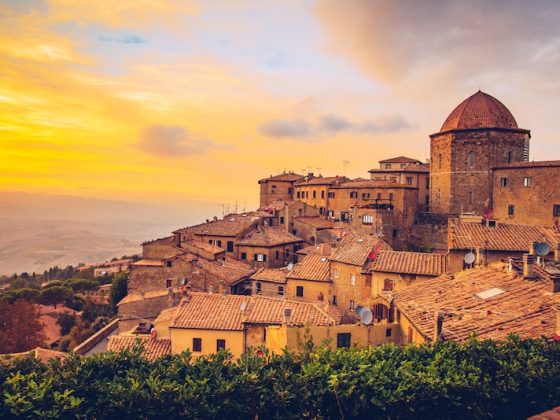
A stunning sunset over the ancient, terracotta-roofed town of Volterra, Italy, a dream location for those considering the country's €1 house experiment.
View Post
  • Property Development
Italy’s €1 House Experiment
  • BY Ethan Rooney
  • January 19, 2026
What It’s Really Like to Live in Tuscany, Italy’s Heartland
View Post
  • Italy
What It’s Really Like to Live in Tuscany, Italy’s Heartland
  • BY EA Editorial Staff
  • October 14, 2025
Cost of Living in Italy: What You’ll Spend (and What You Can Save)
View Post
  • Italy
Cost of Living in Italy: What You’ll Spend (and What You Can Save)
  • BY EA Editorial Staff
  • September 18, 2025
Where old walls meet new beginnings, the €1 home story continues to unfold.
View Post
  • Field Notes
Inside Italy’s $1 Home Revolution
  • BY Isha Sesay
  • July 21, 2025
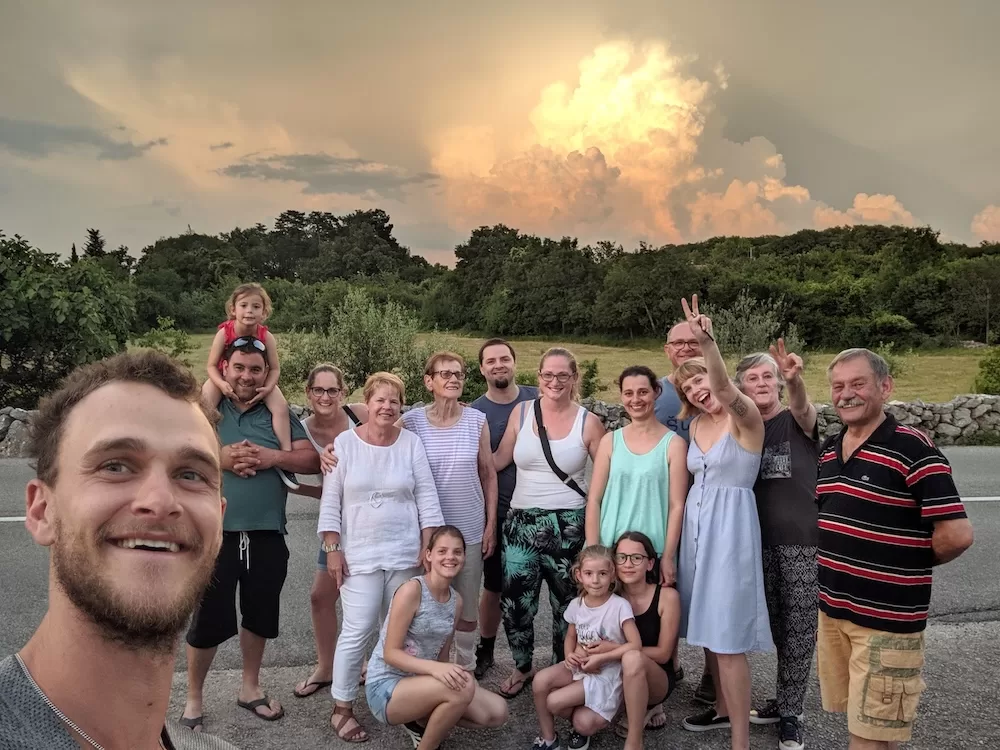
The author with his Croatian cousins.
View Post
  • Italy
Anxiety in Italy, Comfort in Croatia
  • BY Thomas Turcich
  • December 6, 2024
View Post
  • Italy
Living in Italy as an American
  • BY EA Editors
  • October 9, 2024
Want a €3 house in Italy?
View Post
  • Field Notes
Want a €3 house in Italy?
  • BY Lisa Richards
  • July 27, 2023
View Post
  • Italy
What You Need To Know To Move To Italy
  • BY Mikkel Thorup
  • June 1, 2021
Trending Posts
  • Panama City skyline at night with illuminated towers, coastal boulevard, and light trails running along the waterfront 1
    • Plan B
    Ready to Leave the US? These Countries Might Trump the American Dream
    • April 20, 2026
  • Two people sitting on a beach at sunset with waves rolling in and rocky coastline silhouetted against the golden sky 2
    • Costa Rica
    Why Some Expats Leave Costa Rica (and Others Stay Forever)
    • April 17, 2026
  • Chess pieces on a board overlaid with financial charts and data visualizations representing strategic financial planning 3
    • Finance
    Building a Resilient Banking Strategy for Life Abroad
    • April 22, 2026
  • Aerial view of a coastal Portuguese city with hotels, residential buildings, mountains, and the Atlantic shoreline stretching into the distance 4
    • Golden Visa
    Exploring Currency Considerations for Portugal’s Golden Visa
    • April 15, 2026
  • People enjoying the summer at the beach at Lake Ohrid in North Macedonia 5
    • Europe
    Inside North Macedonia: Europe’s Most Unexpected Reinvention
    • April 24, 2026
Subscribe
Know Before You Go
  • Children touching bananas in the tropical climate of Costa Rica 1
    • Costa Rica
    Is Costa Rica the Fresh Start Your Family Is Looking For?
    • April 27, 2026
  • People enjoying the summer at the beach at Lake Ohrid in North Macedonia 2
    • Europe
    Inside North Macedonia: Europe’s Most Unexpected Reinvention
    • April 24, 2026
  • Panama City skyline at night with illuminated towers, coastal boulevard, and light trails running along the waterfront 3
    • Plan B
    Ready to Leave the US? These Countries Might Trump the American Dream
    • April 20, 2026
  • Two people sitting on a beach at sunset with waves rolling in and rocky coastline silhouetted against the golden sky 4
    • Costa Rica
    Why Some Expats Leave Costa Rica (and Others Stay Forever)
    • April 17, 2026
  • Woman walking barefoot along a beach in the Philippines with boats, waterfront buildings, and lush limestone hills in the background 5
    • Digital Nomad
    A Digital Nomad’s Complete Guide to the Philippines
    • April 10, 2026
Learn More
  • About Us
  • Contact
  • Advertise
  • Subscribe
  • Shop
Why Subscribe

The newly imagined Escape Artist brings you fresh content with a global focus, and sharp, up-to-the-minute coverage of the joys, challenges, and opportunities of life abroad.

For a limited time, we’re offering a special discount on all subscription deals, so be sure to lock-in these incredible savings and start receiving top-notch travel and expat content today!

Sign up for the EA Newsletter

Get important news delivered directly to your inbox and stay connected!

This field is for validation purposes and should be left unchanged.
Escape Artist
  • Terms & Conditions
  • Privacy Policy
  • Cookies Policy
  • Disclaimer

Input your search keywords and press Enter.

Escape Artist

The Newsletter for a
Life Beyond Borders

Practical insights and real stories for those building a life abroad, trusted by 75,000 readers worldwide.

This field is for validation purposes and should be left unchanged.

Before you go, want $50 off your Summit registration?

Subscribe, and get $50 discount code for Plan B Summit registration.

Download Your Free Guide

Fill out the form below to get instant access to your guide + receive a $50 discount code for Plan B Summit 2026!

Download Your Free Guide

Fill out the form below to get instant access to your guide + receive a $50 discount code for Plan B Summit 2026!

Download Your Free Guide

Fill out the form below to get instant access to your guide + receive a $50 discount code for Plan B Summit 2026!

Newsletter Subscription