Escape Artist
  • Features
    • Interview
    • Expat News
    • Field Notes
    • Trending
  • Your Plan B
    • Finance
    • Real Estate
    • Second Citizenship
    • Digital Nomad
    • Healthcare
  • Destinations
    • Europe
      • France
      • Germany
      • Italy
      • Portugal
      • Scandinavia
      • Spain
      • United Kingdom
      • Rest of Europe
    • Central America
      • Belize
      • Costa Rica
      • El Salvador
      • Guatemala
      • Honduras
      • Nicaragua
      • Panama
    • Others
      • Africa
      • Asia
      • Australia
      • North America
      • South America
      • Middle East
      • Rest of the World
  • Travel Tips
    • Know Before You Go
    • Packing List
    • Food + Culture
    • Health + Wellness
  • Subscribe
Escape Artist
  • Features
    • Interview
    • Expat News
    • Field Notes
    • Trending
  • Your Plan B
    • Finance
    • Real Estate
    • Second Citizenship
    • Digital Nomad
    • Healthcare
  • Destinations
    • Europe
      • France
      • Germany
      • Italy
      • Portugal
      • Scandinavia
      • Spain
      • United Kingdom
      • Rest of Europe
    • Central America
      • Belize
      • Costa Rica
      • El Salvador
      • Guatemala
      • Honduras
      • Nicaragua
      • Panama
    • Others
      • Africa
      • Asia
      • Australia
      • North America
      • South America
      • Middle East
      • Rest of the World
  • Travel Tips
    • Know Before You Go
    • Packing List
    • Food + Culture
    • Health + Wellness
  • Subscribe
👤

THE NUMBER ONE SOURCE FOR BUILDING A LIFE ABROAD

This field is for validation purposes and should be left unchanged.
  • Your Plan B

A Rolling Stone Escapes

Leaving the “good life” to farm on a Caribbean island

  • BY Sarah Ratliff
  • September 14, 2024
A Rolling Stone Escapes
Photo courtesy of iStock/JC Ruiz
Total
0
Shares
0
0
0

Raised in New York city by the head writer at ABC News, I had my pick of plum jobs after studying at one of the country’s top journalism schools. The problem was that I was unable to settle on any one of them as the years started ticking past. “A rolling stone gathers no moss,” my mother would warn. In truth, I didn’t think I was suited for a news station or corporate life, but I couldn’t yet say it out loud. “We grew up in the Great Depression,” my father would chime in. “Opportunities were few and far between.”

After my mother died in 1994, I moved to Washington, D.C. and met a great guy named Paul. We moved to California, got married, and secured top jobs at a major biotech firm. By the early 2000s, we had healthy bank accounts, a lovely home in the mountains, and far too many vehicles for two people.

But something felt off. It may have been the 60-hour work weeks or that we took two lengthy vacations every year, yet always felt exhausted upon our return. Then there were the troubling symptoms—bouts of vertigo, persistent IBS and daily panic attacks—and tests that revealed I’d been suffering from acute stress.

Finally, some terrible news turned out to be a huge blessing. In mid-2007 I visited my doctor with the usual complaints. She did her check-up, asked a few questions, then looked me dead in the eye and said if I didn’t change my life I wouldn’t see my 45th birthday. I was 41 at the time.

Paul responded to my death sentence with a plan: escape the corporate world for life on a farm. That sounded great to me, so we started watching for “the sign” that told us it was time to make our move. A handful of months later, our employer announced plans to lay off a sizable chunk of the workforce. We gave notice, cashed out our stock, sold our home, and started laying the groundwork for a life of self-sustainable farming. 
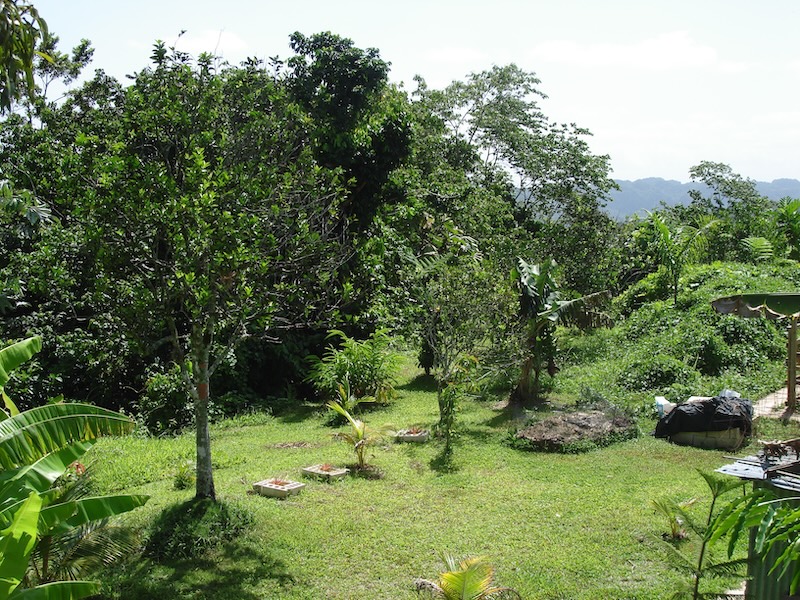
The new property grounds in Puerto Rico. 

La Isla del Encanto
We discussed a few possibilities, but when it came time to decide where to go, one place kept popping up. We’d vacationed in Puerto Rico twice and loved it, particularly the second trip, when we stayed on a farm in the mountain town of Utuado.

By Day Four, we felt as though we’d been wandering the globe aimlessly for years and had finally found our home—like Odysseus reaching Ithaca. We fell so hard for that farm that we asked the owners, an elderly Colombian couple, if we could rent it while we looked for a property of our own. They agreed.

“Why would you give up all of this?!” Paul’s sister asked just before we left the US, arguing that we were throwing all of our parents’ hard work back in their faces. She may have had a point, but we knew we couldn’t keep up the rat-race charade until retirement, then buy an RV and drive around the country. That life held no appeal for us.

We knew five words of Spanish between us, which may have been charming on vacation, but not while living in the sticks.

Sure, we knew five words of Spanish between us, which may have been charming on vacation, but not while living in the sticks. Had we stayed in or near the capital, San Juan, we could have lived the rest of our lives on those five words. But capital city and farming are rarely found in the same sentence. Still, Puerto Rico is not called the Isle of Enchantment for nothing.

Setting aside the threat of hurricanes, we’d have warm weather year-round. A U.S. territory, Puerto Rico meant no immigration process. There was also a clear familiarity, with Home Depot and Walmart everywhere. ATMs spit out dollar bills, so there’s no constant calculating of exchange rates and currency values. And of course, it’s absolutely beautiful.
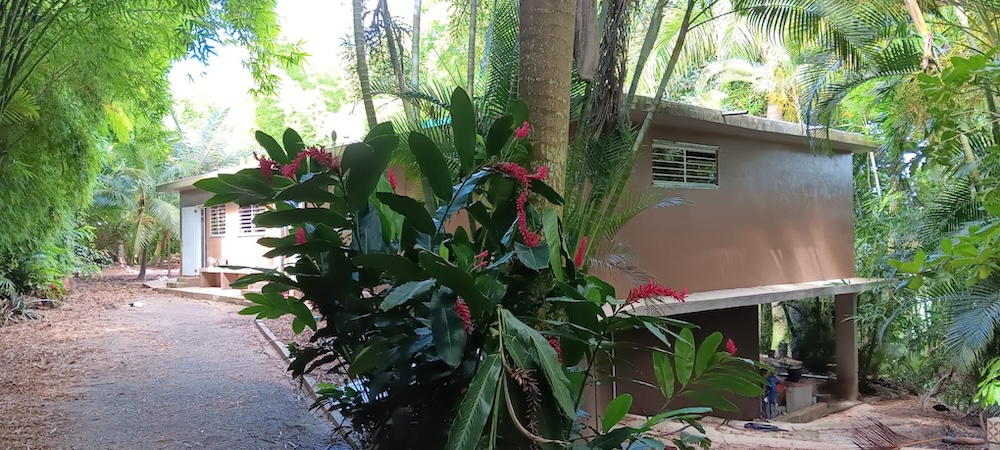
The home after renovations.
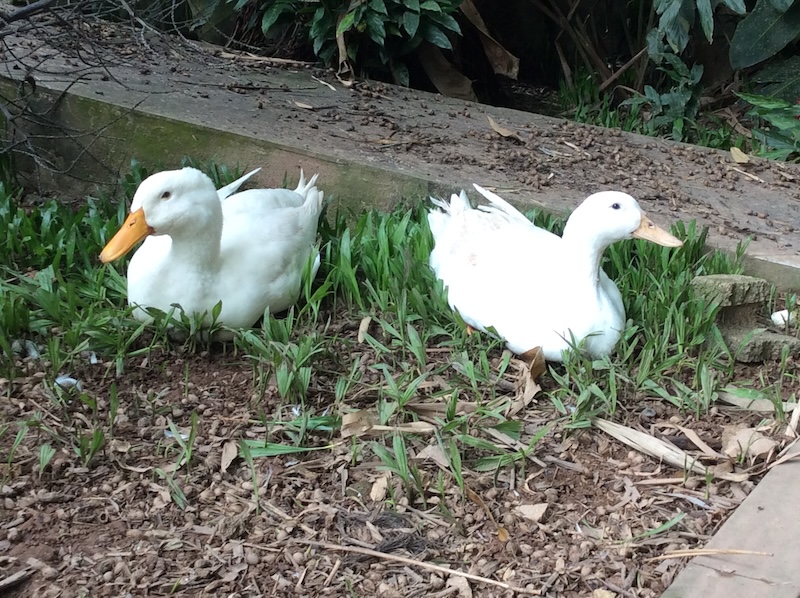
Patrice and Alfie, the resident ducks.

Our New Homestead
After a six-month search that took us all over the island, we visited a 15-acre property a few miles from our rental. Set far back from the rolling country road, it provided a level of privacy and seclusion neither of us had ever experienced before.

The 1500-foot elevation gave us stunning views of a nearby lake and the surrounding countryside, which encouraged the very serenity we were after. We arrived in the early morning, greeted by rising clouds, and imagined ourselves eating breakfast in the sun on our southeast-facing patio.

We could see clear across the valley—not another structure in sight. We knew we’d found our new home. On the last day of 2009, these two rat-race escapees began their new Puerto Rican farm life. We added a big new wing to the tiny old farmhouse, and a sizable patio, enabling us to watch the low clouds burn off in the sun every morning and darkness fall during dinner.

Our arrival, of course, did not go unnoticed. Word spread that two “Americanos” had left the corporate grind to seek purpose on a farm. It didn’t help that, at the time, many Puertoriqueños were leaving the island to seek prosperity elsewhere, primarily due to US trade regulations that heavily favored American businesses.

I can’t blame them. Consider that in the poorest US state, Mississippi, the median income for a family of three is $75,000, while in Puerto Rico it’s barely $32,000. Yet the Jones Act, which requires all imports to arrive on US ships, means most stuff in Puerto Rico—pens and paper, shoes and pants, even pasta and flour—costs 50 percent more than in the U.S.

 Seeking to avoid being lumped in with the snooty expat American crowd, we dove into farm life. We bought starter chickens for eggs and adopted dogs for companionship and security. We met a local Austrian man named Sadhu, who’d learned how to farm in the tropics in India and successfully applied these practices in Puerto Rico.

After visiting his farm, we knew we had to emulate his operation: fruit trees from tropical climates and bamboo from South America, in addition to animals. Sadhu became our mentor and supplier of seeds. He also sold us our first goats, sisters Amani and Mayani, plus a sire named Ravi. We loved them so much we named our new homestead Mayani Farms.

But our favorite neighbor is Olga Zeda—whom I affectionately refer to as La Jefa del Barrio. In short, if you need anything, from garbage pickup to encouraging a suspicious dude hanging around your entrance gate to buzz off, Olga’s your gal. 

We play dominoes with her every chance we get. I’ve gotten really good. Her nephew Miguel once asked us if we were in witness protection because he couldn’t figure out why anybody would give up the SoCal good life to be Caribbean farmers.

Farming in Puerto Rico is not for the soft. Power outages are random, frequent, and often last hours. Power surges are equally problematic.

High Highs and Low Lows 
Miguel had a point: farming in Puerto Rico is not for the soft. Power outages are random, frequent, and often last hours. Power surges are equally problematic. We can never leave the house with the computer or backup battery on.

Of course, homesteading has its delights. Setting aside my freelance writing, there’s nothing like playing with goats, enjoying the antics of 100-plus ducks and chickens, or hiking with our pack of dogs. But it’s a bit like parenting kids who never grow up.
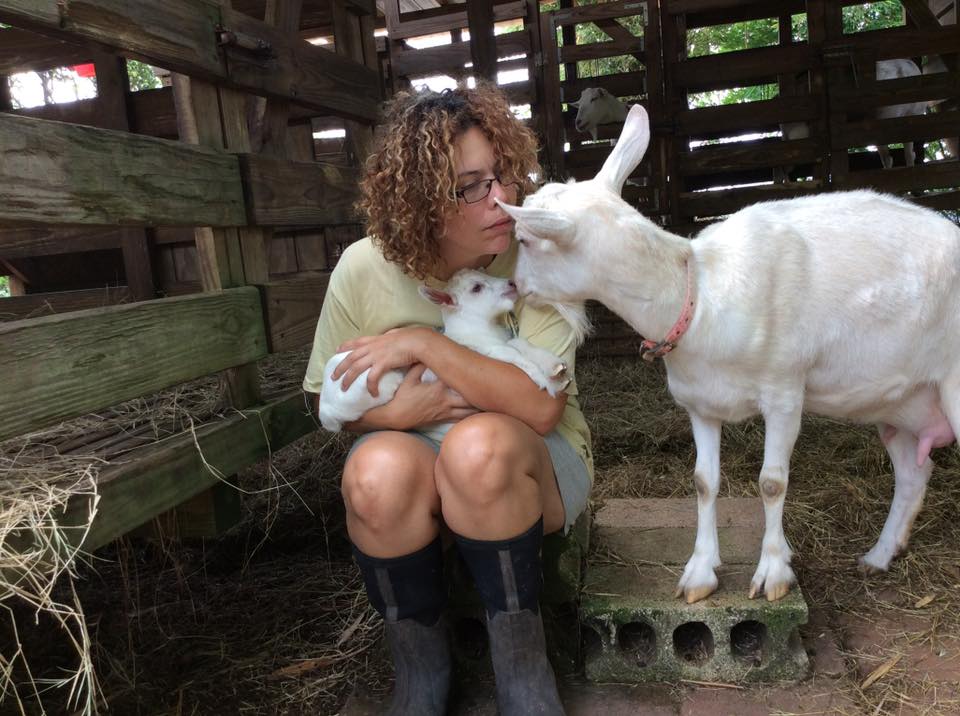
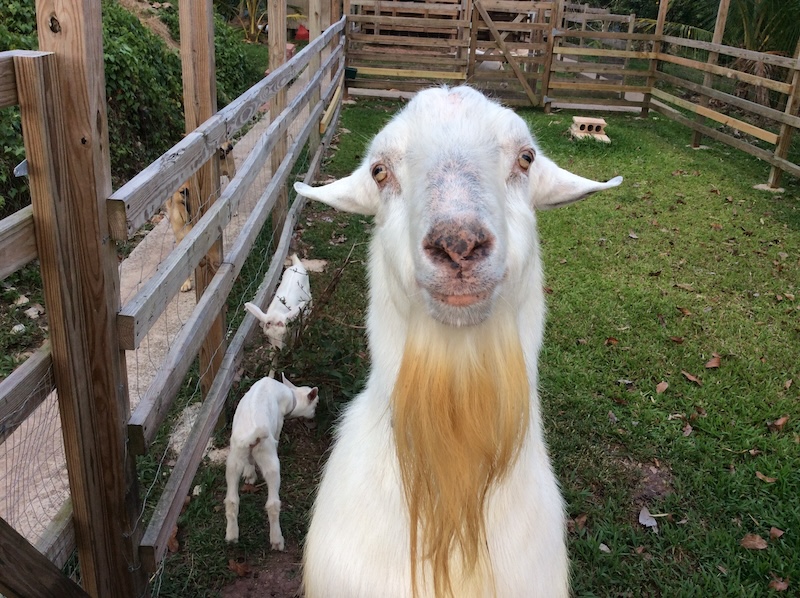
The author with Amani and Goatita.
Ravi and his grandsons.

The emotional stakes are admittedly lower, but the risk is astronomically higher—and we know this all too well. Towards the end of summer 2014, we decided to do our first goat-mating, Amani with Ravi. By the time January arrived, we were all set to welcome Amani’s newborn kids, as young goats are known.

She went into labor, but then nothing happened. We’d read countless articles on goats and birthing, and consulted Sadhu, so we weren’t totally in the dark. Something seemed amiss. Guided by our vet over the phone, Paul started to play midwife, reaching inside Amani to massage her cervix so it would open.
One baby was breech, so I received instructions from the vet and passed them on to Paul who slowly reached in to turn around the tiny goat. Within minutes both were out, searching and sniffing for their mama’s milk. Flooded with emotion, we named them Goatita and Sophie.

Two weeks later, Sophie died from tetanus. It was as crushing as their birth had been uplifting. But a year later, Goatita had kids of her own, twin boys. Overjoyed, we sent out birth announcements to our friends and neighbors.

The farm we had spent nine years building was essentially no more. But we had our health, our land, and our animals, so we got back to work.

The Tempest
We’d just started to find our groove when Hurricane Maria struck with stunning force. We’d ridden out many tropical storms and a few Category 1s and had been preparing for the big one for years. We were confident our house could withstand a Category 5, but we had our concerns. 

As Maria bore down in mid-September 2017, we scrambled to board up windows, secure our animals in shelters, and brace ourselves for the worst. The wind started whipping in the early morning as Maria crossed over the coast and made its way toward Utuado.
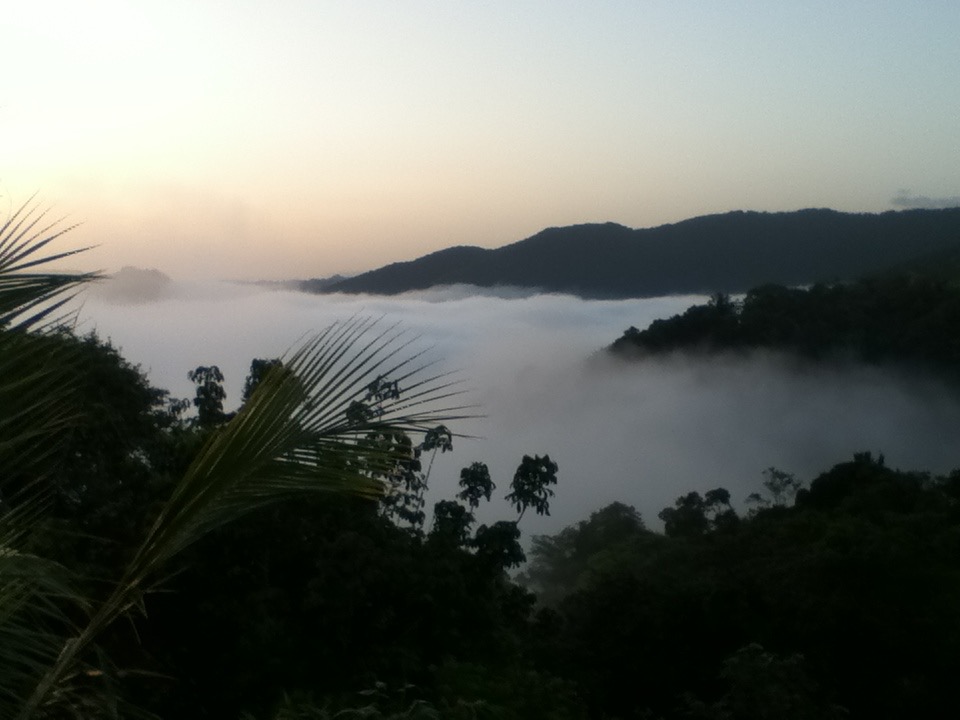
A typical morning on the farm.

By 9:30 am the eye of a Category 4 hurricane stood a few dozen miles from our farm, where ferocious 150-mph winds shattered our greenhouse, sliced off countless massive tree branches and freed most of our young fruit and bamboo trees from the earth.

The wind and rain were so fierce that at one point we wondered if the custom-made “tormentillas” that covered our windows and doors could stop Maria’s fury. But by early afternoon, the worst had passed and we stepped outside to assess the damage. It looked like nature had gone to war with itself—and lost.

The farm we had spent nine years building was essentially no more. But we had our health, our land, and our animals, so we got back to work, as farmers do. It took us four days to clear the debris, which actually provided great organic material.

We may have been luckier than most: the road beyond our gate looked like a Medieval nightmare of mudslides and uprooted trees. Thankfully, Olga’s cousin Macho came around with his backhoe to clear the road and help people out.

Soon, we started to see the outlines of normalcy returning.
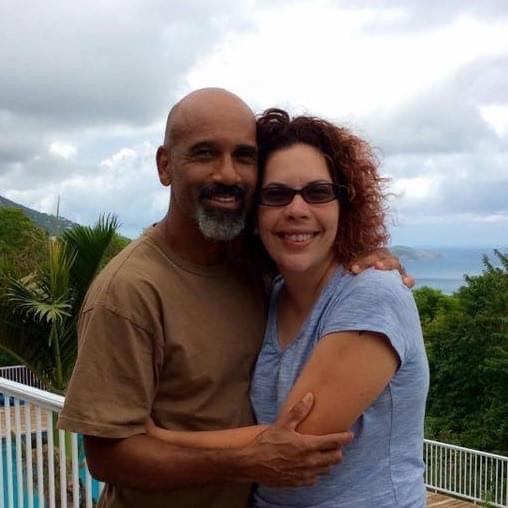
The author and husband, Paul months before Hurricane Maria in St. Thomas.

The Next Big Step
We may not fear the next hurricane, but after Maria we have a healthy respect for nature’s power. We like to think we’re prepared for anything, but we’re in our 60s now and less able to ride the roller coaster of rural farm life.

I fractured my back when I was 18, and now, more than ever, it likes to remind me that my best days are behind me. But more than hurricanes, we fear the vast uncertainty swirling around human civilization. As couples do, Paul and I run through our days over dinner, and talk invariably leads to the future and our place in it.

Whether it’s another pandemic, more hyperinflation, a global depression, World War III, AI coming to take everybody’s jobs or some other catastrophe we have yet to imagine, the future seems like a dark place, so we’re mulling major changes.

One is moving to a smaller, flatter farm, which would do wonders for my back and our efficiency. Also, we’d like to go completely off-grid and move outside the bounds of constant 21st-century connectivity. We’ve been talking about this since we’d arrived, but maybe we needed transition time between our old lives in the new world and new lives in this older world.

Not having internet, besides our phones, is one thing. What’s worse is that I’ll need to stop my writing, which means we’re more than likely to be poor, truly poor, by almost any metric.

But to be honest, I never understood why moss should be seen as desirable. If I come upon two stones in the woods, and one is covered in moss and the other is glistening and gray, my eyes and mind will tend toward the latter.

We recently put our farm on the market. We hope a young couple will see it and fall in love the way we did years ago. And this stone will keep rolling on. ■

————–
Sarah Ratliff is a corporate America escapee turned writer and eco-organic farmer in the mountains of Puerto Rico. Find more of her work here.

Sarah Ratliff

Contact Author

"*" indicates required fields

This field is for validation purposes and should be left unchanged.
Name*
Please let us know what's on your mind. Have a question for us? Ask away.

Stay Ahead on Every Adventure! 

Stay updated with the World News on Escape Artist. Get all the travel news, international destinations, expat living, moving abroad, Lifestyle Tips, and digital nomad opportunities. Your next journey starts here—don’t miss a moment! Subscribe Now!

Raised in New York city by the head writer at ABC News, I had my pick of plum jobs after studying at one of the country’s top journalism schools. The problem was that I was unable to settle on any one of them as the years started ticking past. “A rolling stone gathers no moss,” my mother would warn. In truth, I didn’t think I was suited for a news station or corporate life, but I couldn’t yet say it out loud. “We grew up in the Great Depression,” my father would chime in. “Opportunities were few and far between.”

After my mother died in 1994, I moved to Washington, D.C. and met a great guy named Paul. We moved to California, got married, and secured top jobs at a major biotech firm. By the early 2000s, we had healthy bank accounts, a lovely home in the mountains, and far too many vehicles for two people.

But something felt off. It may have been the 60-hour work weeks or that we took two lengthy vacations every year, yet always felt exhausted upon our return. Then there were the troubling symptoms—bouts of vertigo, persistent IBS and daily panic attacks—and tests that revealed I’d been suffering from acute stress.

Finally, some terrible news turned out to be a huge blessing. In mid-2007 I visited my doctor with the usual complaints. She did her check-up, asked a few questions, then looked me dead in the eye and said if I didn’t change my life I wouldn’t see my 45th birthday. I was 41 at the time.

Paul responded to my death sentence with a plan: escape the corporate world for life on a farm. That sounded great to me, so we started watching for “the sign” that told us it was time to make our move. A handful of months later, our employer announced plans to lay off a sizable chunk of the workforce. We gave notice, cashed out our stock, sold our home, and started laying the groundwork for a life of self-sustainable farming. 

La Isla del Encanto
We discussed a few possibilities, but when it came time to decide where to go, one place kept popping up. We’d vacationed in Puerto Rico twice and loved it, particularly the second trip, when we stayed on a farm in the mountain town of Utuado.

By Day Four, we felt as though we’d been wandering the globe aimlessly for years and had finally found our home—like Odysseus reaching Ithaca. We fell so hard for that farm that we asked the owners, an elderly Colombian couple, if we could rent it while we looked for a property of our own. They agreed.

“Why would you give up all of this?!” Paul’s sister asked just before we left the US, arguing that we were throwing all of our parents’ hard work back in their faces. She may have had a point, but we knew we couldn’t keep up the rat-race charade until retirement, then buy an RV and drive around the country. That life held no appeal for us.

We knew five words of Spanish between us, which may have been charming on vacation, but not while living in the sticks.

Sure, we knew five words of Spanish between us, which may have been charming on vacation, but not while living in the sticks. Had we stayed in or near the capital, San Juan, we could have lived the rest of our lives on those five words. But capital city and farming are rarely found in the same sentence. Still, Puerto Rico is not called the Isle of Enchantment for nothing.

Setting aside the threat of hurricanes, we’d have warm weather year-round. A U.S. territory, Puerto Rico meant no immigration process. There was also a clear familiarity, with Home Depot and Walmart everywhere. ATMs spit out dollar bills, so there’s no constant calculating of exchange rates and currency values. And of course, it’s absolutely beautiful.

Our New Homestead
After a six-month search that took us all over the island, we visited a 15-acre property a few miles from our rental. Set far back from the rolling country road, it provided a level of privacy and seclusion neither of us had ever experienced before.

The 1500-foot elevation gave us stunning views of a nearby lake and the surrounding countryside, which encouraged the very serenity we were after. We arrived in the early morning, greeted by rising clouds, and imagined ourselves eating breakfast in the sun on our southeast-facing patio.

We could see clear across the valley—not another structure in sight. We knew we’d found our new home. On the last day of 2009, these two rat-race escapees began their new Puerto Rican farm life. We added a big new wing to the tiny old farmhouse, and a sizable patio, enabling us to watch the low clouds burn off in the sun every morning and darkness fall during dinner.

Our arrival, of course, did not go unnoticed. Word spread that two “Americanos” had left the corporate grind to seek purpose on a farm. It didn’t help that, at the time, many Puertoriqueños were leaving the island to seek prosperity elsewhere, primarily due to US trade regulations that heavily favored American businesses.

I can’t blame them. Consider that in the poorest US state, Mississippi, the median income for a family of three is $75,000, while in Puerto Rico it’s barely $32,000. Yet the Jones Act, which requires all imports to arrive on US ships, means most stuff in Puerto Rico—pens and paper, shoes and pants, even pasta and flour—costs 50 percent more than in the U.S.

 Seeking to avoid being lumped in with the snooty expat American crowd, we dove into farm life. We bought starter chickens for eggs and adopted dogs for companionship and security. We met a local Austrian man named Sadhu, who’d learned how to farm in the tropics in India and successfully applied these practices in Puerto Rico.

After visiting his farm, we knew we had to emulate his operation: fruit trees from tropical climates and bamboo from South America, in addition to animals. Sadhu became our mentor and supplier of seeds. He also sold us our first goats, sisters Amani and Mayani, plus a sire named Ravi. We loved them so much we named our new homestead Mayani Farms.

But our favorite neighbor is Olga Zeda—whom I affectionately refer to as La Jefa del Barrio. In short, if you need anything, from garbage pickup to encouraging a suspicious dude hanging around your entrance gate to buzz off, Olga’s your gal. 

We play dominoes with her every chance we get. I’ve gotten really good. Her nephew Miguel once asked us if we were in witness protection because he couldn’t figure out why anybody would give up the SoCal good life to be Caribbean farmers.

Farming in Puerto Rico is not for the soft. Power outages are random, frequent, and often last hours. Power surges are equally problematic.

High Highs and Low Lows 
Miguel had a point: farming in Puerto Rico is not for the soft. Power outages are random, frequent, and often last hours. Power surges are equally problematic. We can never leave the house with the computer or backup battery on.

Of course, homesteading has its delights. Setting aside my freelance writing, there’s nothing like playing with goats, enjoying the antics of 100-plus ducks and chickens, or hiking with our pack of dogs. But it’s a bit like parenting kids who never grow up.

The emotional stakes are admittedly lower, but the risk is astronomically higher—and we know this all too well. Towards the end of summer 2014, we decided to do our first goat-mating, Amani with Ravi. By the time January arrived, we were all set to welcome Amani’s newborn kids, as young goats are known.

She went into labor, but then nothing happened. We’d read countless articles on goats and birthing, and consulted Sadhu, so we weren’t totally in the dark. Something seemed amiss. Guided by our vet over the phone, Paul started to play midwife, reaching inside Amani to massage her cervix so it would open.

One baby was breech, so I received instructions from the vet and passed them on to Paul who slowly reached in to turn around the tiny goat. Within minutes both were out, searching and sniffing for their mama’s milk. Flooded with emotion, we named them Goatita and Sophie.

Two weeks later, Sophie died from tetanus. It was as crushing as their birth had been uplifting. But a year later, Goatita had kids of her own, twin boys. Overjoyed, we sent out birth announcements to our friends and neighbors.

The farm we had spent nine years building was essentially no more. But we had our health, our land, and our animals, so we got back to work.

The Tempest
We’d just started to find our groove when Hurricane Maria struck with stunning force. We’d ridden out many tropical storms and a few Category 1s and had been preparing for the big one for years. We were confident our house could withstand a Category 5, but we had our concerns. 

As Maria bore down in mid-September 2017, we scrambled to board up windows, secure our animals in shelters, and brace ourselves for the worst. The wind started whipping in the early morning as Maria crossed over the coast and made its way toward Utuado.

By 9:30 am the eye of a Category 4 hurricane stood a few dozen miles from our farm, where ferocious 150-mph winds shattered our greenhouse, sliced off countless massive tree branches and freed most of our young fruit and bamboo trees from the earth.

The wind and rain were so fierce that at one point we wondered if the custom-made “tormentillas” that covered our windows and doors could stop Maria’s fury. But by early afternoon, the worst had passed and we stepped outside to assess the damage. It looked like nature had gone to war with itself—and lost.

The farm we had spent nine years building was essentially no more. But we had our health, our land, and our animals, so we got back to work, as farmers do. It took us four days to clear the debris, which actually provided great organic material.

We may have been luckier than most: the road beyond our gate looked like a Medieval nightmare of mudslides and uprooted trees. Thankfully, Olga’s cousin Macho came around with his backhoe to clear the road and help people out.

Soon, we started to see the outlines of normalcy returning.

The Next Big Step
We may not fear the next hurricane, but after Maria we have a healthy respect for nature’s power. We like to think we’re prepared for anything, but we’re in our 60s now and less able to ride the roller coaster of rural farm life.

I fractured my back when I was 18, and now, more than ever, it likes to remind me that my best days are behind me. But more than hurricanes, we fear the vast uncertainty swirling around human civilization. As couples do, Paul and I run through our days over dinner, and talk invariably leads to the future and our place in it.

Whether it’s another pandemic, more hyperinflation, a global depression, World War III, AI coming to take everybody’s jobs or some other catastrophe we have yet to imagine, the future seems like a dark place, so we’re mulling major changes.

One is moving to a smaller, flatter farm, which would do wonders for my back and our efficiency. Also, we’d like to go completely off-grid and move outside the bounds of constant 21st-century connectivity. We’ve been talking about this since we’d arrived, but maybe we needed transition time between our old lives in the new world and new lives in this older world.

Not having internet, besides our phones, is one thing. What’s worse is that I’ll need to stop my writing, which means we’re more than likely to be poor, truly poor, by almost any metric.

But to be honest, I never understood why moss should be seen as desirable. If I come upon two stones in the woods, and one is covered in moss and the other is glistening and gray, my eyes and mind will tend toward the latter.

We recently put our farm on the market. We hope a young couple will see it and fall in love the way we did years ago. And this stone will keep rolling on. ■

————–
Sarah Ratliff is a corporate America escapee turned writer and eco-organic farmer in the mountains of Puerto Rico. Find more of her work here.

Sarah Ratliff

Contact Author

"*" indicates required fields

If you'd like to read the full story, simply enter your email to subscribe to our newsletter.

For even more expert insights, unmissable resources, and exclusive invites, explore our premium subscription offers here.

This field is for validation purposes and should be left unchanged.


OR

Subscribe Now

Already a Subscriber? Click here to login

Subscription required

You've reached your limit of free articles. For full access to Escape Artist, and all of our insights on travel, moving abroad, and the digital nomad life, click here to Subscribe.

Already a Subscriber? Log in here

Total
0
Shares
Share 0
Tweet 0
Pin it 0
Previous Article
11 Reasons Not to Move to France, a woman looking frustrated at a cafe table with papers while navigating moving to France
  • Expat News

11 Reasons Not to Move to France

  • BY David Lepeska
  • September 12, 2024
View Post
Next Article
The World Nomad Games Come to a Close in Astana
  • Expat News

The World Nomad Games Come to a Close in Astana

  • BY Aaron Kenedi
  • September 16, 2024
View Post
You May Also Like
How to Secure Hungarian Citizenship Yourself Step-by-Step Guide
View Post
  • Second Citizenship
DIY How to Secure Hungarian Citizenship Yourself
  • BY Ethan Cohen & Learn Hungarian Anywhere
  • April 29, 2026
Magnifying glass focused on Estonia and the Baltic region on a printed map of Northern and Eastern Europe.
View Post
  • Second Citizenship
Estonia’s e-Residency and a New Kind of Nation
  • BY Ethan Rooney
  • April 29, 2026
Children touching bananas in the tropical climate of Costa Rica
View Post
  • Costa Rica
Is Costa Rica the Fresh Start Your Family Is Looking For?
  • BY Carla Rodrigues
  • April 27, 2026
Chess pieces on a board overlaid with financial charts and data visualizations representing strategic financial planning
View Post
  • Finance
Building a Resilient Banking Strategy for Life Abroad
  • BY Isha Sesay
  • April 22, 2026
Two students walking across a university campus at sunset, representing international schooling, higher education, and study abroad opportunities.
View Post
  • Second Residency
Raising Global Kids Without Breaking the Bank
  • BY EA Editorial Staff
  • April 22, 2026
Panama City skyline at night with illuminated towers, coastal boulevard, and light trails running along the waterfront
View Post
  • Plan B
Ready to Leave the US? These Countries Might Trump the American Dream
  • BY Emily Draper
  • April 20, 2026
Aerial view of a coastal Portuguese city with hotels, residential buildings, mountains, and the Atlantic shoreline stretching into the distance
View Post
  • Golden Visa
Exploring Currency Considerations for Portugal’s Golden Visa
  • BY Iva Slavtcheva
  • April 15, 2026
Evening street scene in Dubai with illuminated digital billboards, pedestrians, and modern skyscrapers rising in the background
View Post
  • Plan B
Geopolitical Risk and the Shift Beyond the Gulf
  • BY Luigi Wewege
  • April 8, 2026
Trending Posts
  • Panama City skyline at night with illuminated towers, coastal boulevard, and light trails running along the waterfront 1
    • Plan B
    Ready to Leave the US? These Countries Might Trump the American Dream
    • April 20, 2026
  • Two people sitting on a beach at sunset with waves rolling in and rocky coastline silhouetted against the golden sky 2
    • Costa Rica
    Why Some Expats Leave Costa Rica (and Others Stay Forever)
    • April 17, 2026
  • Chess pieces on a board overlaid with financial charts and data visualizations representing strategic financial planning 3
    • Finance
    Building a Resilient Banking Strategy for Life Abroad
    • April 22, 2026
  • People enjoying the summer at the beach at Lake Ohrid in North Macedonia 4
    • Europe
    Inside North Macedonia: Europe’s Most Unexpected Reinvention
    • April 24, 2026
  • Children touching bananas in the tropical climate of Costa Rica 5
    • Costa Rica
    Is Costa Rica the Fresh Start Your Family Is Looking For?
    • April 27, 2026
Subscribe
Know Before You Go
  • How to Secure Hungarian Citizenship Yourself Step-by-Step Guide 1
    • Second Citizenship
    DIY How to Secure Hungarian Citizenship Yourself
    • April 29, 2026
  • Children touching bananas in the tropical climate of Costa Rica 2
    • Costa Rica
    Is Costa Rica the Fresh Start Your Family Is Looking For?
    • April 27, 2026
  • People enjoying the summer at the beach at Lake Ohrid in North Macedonia 3
    • Europe
    Inside North Macedonia: Europe’s Most Unexpected Reinvention
    • April 24, 2026
  • Panama City skyline at night with illuminated towers, coastal boulevard, and light trails running along the waterfront 4
    • Plan B
    Ready to Leave the US? These Countries Might Trump the American Dream
    • April 20, 2026
  • Two people sitting on a beach at sunset with waves rolling in and rocky coastline silhouetted against the golden sky 5
    • Costa Rica
    Why Some Expats Leave Costa Rica (and Others Stay Forever)
    • April 17, 2026
Learn More
  • About Us
  • Contact
  • Advertise
  • Subscribe
  • Shop
Why Subscribe

The newly imagined Escape Artist brings you fresh content with a global focus, and sharp, up-to-the-minute coverage of the joys, challenges, and opportunities of life abroad.

For a limited time, we’re offering a special discount on all subscription deals, so be sure to lock-in these incredible savings and start receiving top-notch travel and expat content today!

Sign up for the EA Newsletter

Get important news delivered directly to your inbox and stay connected!

This field is for validation purposes and should be left unchanged.
Escape Artist
  • Terms & Conditions
  • Privacy Policy
  • Cookies Policy
  • Disclaimer

Input your search keywords and press Enter.

Escape Artist

The Newsletter for a
Life Beyond Borders

Practical insights and real stories for those building a life abroad, trusted by 75,000 readers worldwide.

This field is for validation purposes and should be left unchanged.

Before you go, want $50 off your Summit registration?

Subscribe, and get $50 discount code for Plan B Summit registration.

Download Your Free Guide

Fill out the form below to get instant access to your guide + receive a $50 discount code for Plan B Summit 2026!

Download Your Free Guide

Fill out the form below to get instant access to your guide + receive a $50 discount code for Plan B Summit 2026!

Download Your Free Guide

Fill out the form below to get instant access to your guide + receive a $50 discount code for Plan B Summit 2026!

Newsletter Subscription