Most of what you leave your children will be gone before your grandchildren are grown. And it is not because you didn’t leave enough.
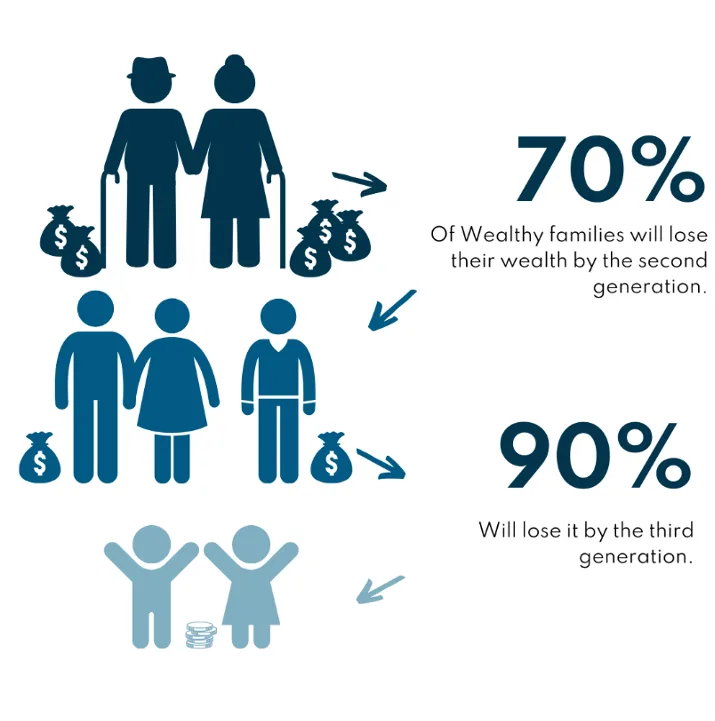
A twenty-year study by the Williams Group, covering more than 3,200 families, found that 70% of wealthy families lose their wealth by the second generation. By the third, it is 90%.
So, let’s look at other data. When two economists tracked households through census records, they found that 85% of families in the wealthiest 0.1% had dropped out of that group within ten years.
For the “top 1%”, 72% fell out over the same period.
Now here is the part nobody expects.
When the Williams researchers went looking for the cause, only about 3% of the failures traced back to legal, tax, or structural problems. The wills were fine. The trusts were fine. The lawyers had done their jobs.
The other 97 % of failure was people and relationships.
Families that had never talked about money. Heirs who inherited a mansion they’d never been inside. A Bank of America survey found that when high-net-worth parents discussed their plans with adult children, the average child was 31 years old before that conversation happened.
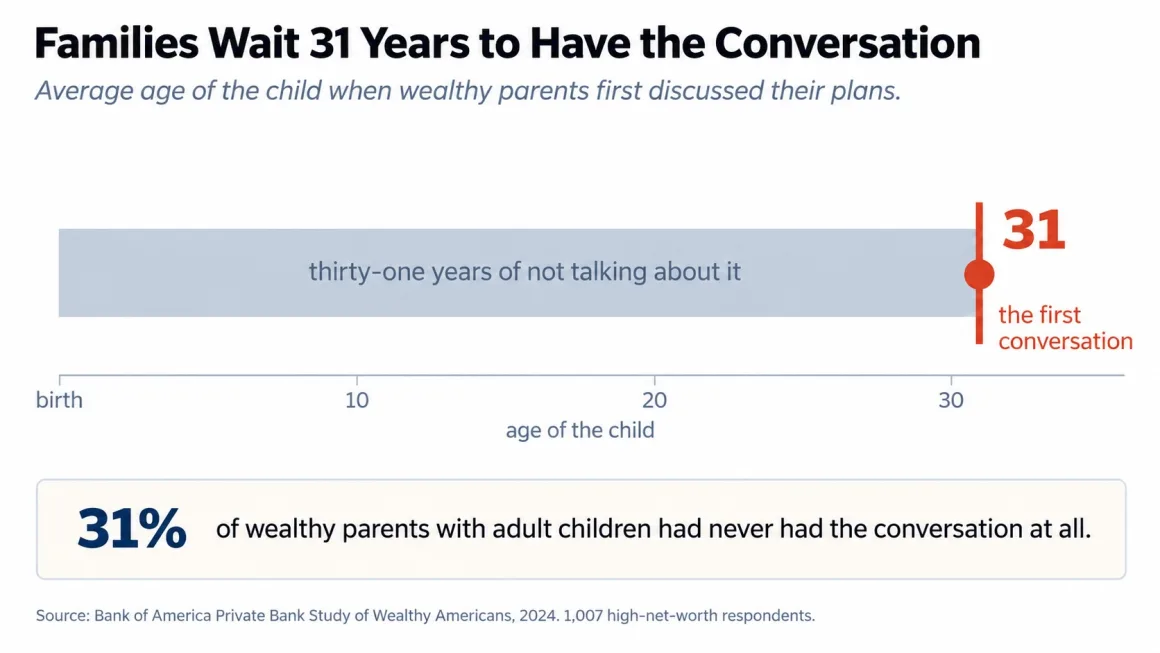
31! And that is the group who did it!
I want to be careful here, this is not going to turn into a lecture about spoiled children. That is not what the data says. The data says the parents didn’t do their job.
Which is a very different problem, and thankfully for you, a much more fixable one.
So, let’s say we do the obvious thing. We call the attorney. We set up the trust. We update the will. We feel better.
We’ve only solved 3% of the problem.
What about the other 97%
An estate plan is an instruction. It tells someone what to do with something after you are gone. It’s necessary and you should do it. But don’t stop there.
The instructions you leave your children say nothing about why the money exists, what it cost to make, and what it takes to keep it.
30 years of building 3 businesses in Central America has taught me that patience is learned and earned.
Stewardship
What you actually want to teach is stewardship, and stewardship is not a concept. It is a habit. It comes from tending something over a long enough period that you feel the weight of the time. It is a muscle that is only developed through consistency.
Which means you cannot lecture it into them. You show them all the time, you show them by handing them something that requires it.
What I planted in 1999
In 1999 we planted our first Teak saplings in Panama, on ground that had been a cattle pasture.
The reason most people don’t plant Timber is always the same. Teak, Timber specifically takes twenty-five years. That is a long time to wait.
The reason I did it is solid. Twenty-five years was going to pass either way. The difference is that I have something standing at the end of it.
That first farm is coming up on its first harvest.
I have watched families come down to see their trees. Parents who bought a parcel, and children who were small when it went in the ground and are now grown, walking through Timber that is taller than the house they were raised in. Nobody has to explain compounding to those kids.
They are standing in it.
That is the lesson. Not the harvest. The walk.

What a tree can do that a trust cannot
A Teak parcel is titled land. Your name is on it. You can pass it to your children, to your grandchildren, or to a cause you care about. You can hold it in a Panamanian foundation. You can visit it, and you should.
You own trees you can stand under. You pass a stewardship lesson your children cannot inherit without living it.
Our trees grew through 2001. They grew through 2008, while the markets came apart. And they grew through 2020 and all the Covid era issues.
Over the past several decades, the wholesale price of Teak has risen at an average of about 5.5% a year. That is a fine number. It is not the point.
A brokerage statement shows a child the result. A 25-year-old tree shows them patience. And that is the part worth passing down. The ability to hold the asset.
Give someone money and well… they may or may not have money tomorrow. Give them an asset, the patience to steward it and that is generational wealth.
What I would actually do
Do the estate plan. Get the will, the trust, the directives. Solve the 3%, because unsolved it will cost your family more than the money.
Then solve the other 97%.
Tell your children what you own and why. Not when they are 31. Now, at whatever age they are, in whatever language fits.
Take them to see it. Whatever it is. If it is a business, walk them through it. If it is land, stand on it.
And give them something that has to be tended. Something with a horizon longer than their patience, so that patience is what they build.
The old line is that the best time to plant a tree was 25 years ago, and the second best time is now.
It is true about trees. It is truer about the conversation you have been putting off. Have it this month.
You are not trying to leave them money. You are trying to leave them the ability to keep it and a legacy to build on.
See you down here,
Michael K. Cobb
P.S. My trees are in Panama, in the Darién, and the first farm reaches harvest this year. We take people down a few times a year to walk it and visit the sawmill we built too. If you want to see what a twenty-six year asset looks like, come and stand in one. Maybe you’ll want to own one for your legacy too. For more information, visit teakhardwoods.com
About the Author
Michael K. Cobb is a 20 year expat and entrepreneur who has spent the majority of his life working with everyday aspiring expats to help them move abroad. He recently published his first book, How to Buy Your Home Overseas and Get It Right the First Time.
Contact Author
"*" indicates required fields
Stay Ahead on Every Adventure!
Stay updated with the World News on Escape Artist. Get all the travel news, international destinations, expat living, moving abroad, Lifestyle Tips, and digital nomad opportunities. Your next journey starts here—don’t miss a moment! Subscribe Now !
Most of what you leave your children will be gone before your grandchildren are grown. And it is not because you didn’t leave enough.
A twenty-year study by the Williams Group, covering more than 3,200 families, found that 70% of wealthy families lose their wealth by the second generation. By the third, it is 90%.
So, let’s look at other data. When two economists tracked households through census records, they found that 85% of families in the wealthiest 0.1% had dropped out of that group within ten years.
If you'd like to read the full story, simply enter your email to subscribe to our newsletter.
For even more expert insights, unmissable resources, and exclusive invites, explore our premium subscription offers here.
OR
Already a Subscriber? Click here to login
Subscription required
You've reached your limit of free articles. For full access to Escape Artist, and all of our insights on travel, moving abroad, and the digital nomad life, click here to Subscribe.
Already a Subscriber? Log in here