So why Phuket, out of everywhere in Thailand?
Ask five different expats why they landed on Phuket instead of Bangkok or Chiang Mai and you’ll probably get five different answers. Beaches. Flights. The food. One guy will say it’s the pace, another will say it’s the international school for his kids. But underneath all of it there’s usually one shared reason: the island lets people live somewhere tropical without giving up the basics – decent internet, private hospitals, an airport that connects straight to Singapore and Kuala Lumpur. That combination isn’t as common in Southeast Asia as people assume, and it’s a big part of why retirees, remote workers, and families keep choosing it year after year.
It’s not without headaches, though. High season brings real traffic near Patong. Rent shifts a lot depending on how close you are to the water. And the paperwork – this is Thailand, so patience is basically a requirement, not a personality trait. Still, people who plan ahead tend to land on their feet here.
Choosing a neighborhood (this is where people usually go wrong)
Newcomers book a condo in Patong because it’s the name they’ve heard, then six months in they’re wondering why they didn’t look elsewhere first. Patong is loud and built for short tourist stays – great for a week, rough for a life.
Some areas worth actually considering:
- Rawai and Nai Harn – quieter, popular with long-term expats and families, near calmer beaches
- Chalong – inland, practical, known for its fitness and diving crowd, usually cheaper
- Kata and Karon – a decent middle ground between beach access and something less chaotic than Patong
- Bang Tao and Laguna – upscale villas and resort-style condos, popular with families and remote professionals with a bit more budget
Renting for a few months before signing anything long-term is what nearly every experienced expat recommends. Photos never quite show how far a place really is from the nearest proper grocery store.
Getting around – and why fewer expats are relying on scooters these days
Scooters are cheap, they’re everywhere, and that’s exactly why most newcomers default to renting one within a day of landing. But Phuket’s roads have a genuine accident problem, and the island itself doesn’t do scooters any favors either – hilly stretches, sudden downpours for a good chunk of the year, distances that add up fast.
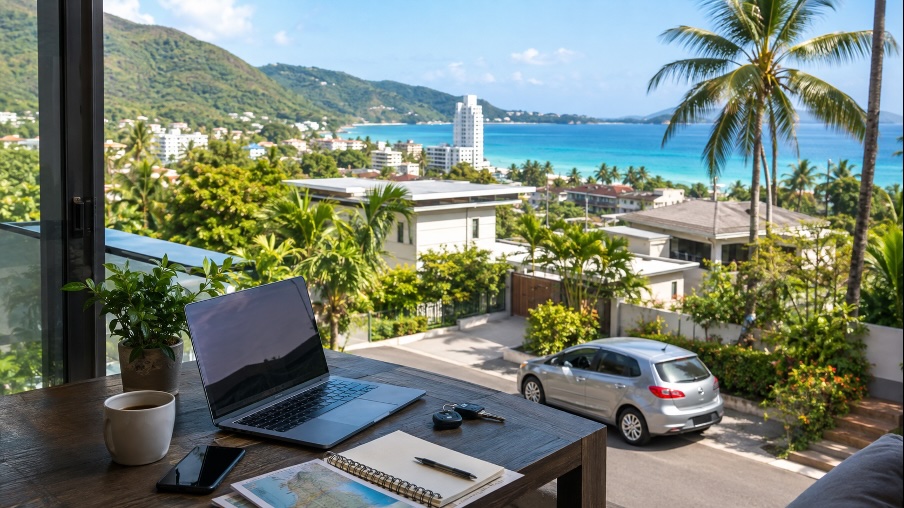
For anyone staying longer than a couple of weeks – especially with kids, luggage, or a laptop bag full of work gear – going with a car rental Phuket option just makes the day-to-day easier. It solves problems a scooter can’t: getting from Rawai to the airport with bags, hauling groceries back from Chalong, driving up to Bang Tao for the day without arriving soaked. Comparing options ahead of time beats negotiating with a stall the moment you land, and it means arriving with transport already sorted.
Foreigners driving in Thailand need an international driving permit – worth sorting before departure, not after touching down.
Visas: the part nobody looks forward to
Thailand’s visa rules have shifted more than once in recent years, and Phuket hasn’t been spared any of the paperwork. Broadly, expats land in one of a few categories: retirement visas for those over 50, long-term resident visas aimed at remote workers and higher earners, education visas for people studying Thai (or something else), and standard tourist visas for anyone not yet committed to staying.
None of this is worth guessing at. Income thresholds, insurance minimums, renewal timelines – these change, and immigration offices don’t always interpret the rules the same way twice. A visa agent or immigration lawyer in Phuket is usually money well spent, especially the first time around.
What it actually costs to live here
Costs swing a lot depending on lifestyle and neighborhood, but a few patterns hold up. Rent drops noticeably once you move inland – a one-bedroom away from the beach costs meaningfully less than the same size unit with a sea view. Local Thai food stays cheap by almost any international measure; imported groceries and Western restaurants are where budgets start climbing.
Healthcare deserves its own line item. Phuket’s private hospitals are well-regarded across the region, but they’re not free, and most long-term expats carry international health insurance rather than gambling on out-of-pocket costs.
Final thoughts
Phuket doesn’t reward winging it. The neighborhoods, the visa categories, even the traffic patterns are specific enough that a little homework upfront saves real headaches down the line. But for people willing to do that groundwork – right area, transport and paperwork sorted before arrival, an honest budget – the island tends to deliver exactly what draws people to it in the first place: warm weather, a real community of long-term foreigners, and a pace of life Bangkok and Chiang Mai just don’t match.
Contact Author
"*" indicates required fields
Stay Ahead on Every Adventure!
Stay updated with the World News on Escape Artist. Get all the travel news, international destinations, expat living, moving abroad, Lifestyle Tips, and digital nomad opportunities. Your next journey starts here—don’t miss a moment! Subscribe Now !
So why Phuket, out of everywhere in Thailand?
Ask five different expats why they landed on Phuket instead of Bangkok or Chiang Mai and you’ll probably get five different answers. Beaches. Flights. The food. One guy will say it’s the pace, another will say it’s the international school for his kids. But underneath all of it there’s usually one shared reason: the island lets people live somewhere tropical without giving up the basics – decent internet, private hospitals, an airport that connects straight to Singapore and Kuala Lumpur. That combination isn’t as common in Southeast Asia as people assume, and it’s a big part of why retirees, remote workers, and families keep choosing it year after year.
It’s not without headaches, though. High season brings real traffic near Patong. Rent shifts a lot depending on how close you are to the water. And the paperwork – this is Thailand, so patience is basically a requirement, not a personality trait. Still, people who plan ahead tend to land on their feet here.
If you'd like to read the full story, simply enter your email to subscribe to our newsletter.
For even more expert insights, unmissable resources, and exclusive invites, explore our premium subscription offers here.
OR
Already a Subscriber? Click here to login
Subscription required
You've reached your limit of free articles. For full access to Escape Artist, and all of our insights on travel, moving abroad, and the digital nomad life, click here to Subscribe.
Already a Subscriber? Log in here