Escape Artist
  • Features
    • Interview
    • Expat News
    • Field Notes
    • Trending
  • Your Plan B
    • Finance
    • Real Estate
    • Second Citizenship
    • Digital Nomad
    • Healthcare
  • Destinations
    • Europe
      • France
      • Germany
      • Italy
      • Portugal
      • Scandinavia
      • Spain
      • United Kingdom
      • Rest of Europe
    • Central America
      • Belize
      • Costa Rica
      • El Salvador
      • Guatemala
      • Honduras
      • Nicaragua
      • Panama
    • Others
      • Africa
      • Asia
      • Australia
      • North America
      • South America
      • Middle East
      • Rest of the World
  • Travel Tips
    • Know Before You Go
    • Packing List
    • Food + Culture
    • Health + Wellness
  • Subscribe
Escape Artist
  • Features
    • Interview
    • Expat News
    • Field Notes
    • Trending
  • Your Plan B
    • Finance
    • Real Estate
    • Second Citizenship
    • Digital Nomad
    • Healthcare
  • Destinations
    • Europe
      • France
      • Germany
      • Italy
      • Portugal
      • Scandinavia
      • Spain
      • United Kingdom
      • Rest of Europe
    • Central America
      • Belize
      • Costa Rica
      • El Salvador
      • Guatemala
      • Honduras
      • Nicaragua
      • Panama
    • Others
      • Africa
      • Asia
      • Australia
      • North America
      • South America
      • Middle East
      • Rest of the World
  • Travel Tips
    • Know Before You Go
    • Packing List
    • Food + Culture
    • Health + Wellness
  • Subscribe
👤

THE NUMBER ONE SOURCE FOR BUILDING A LIFE ABROAD

This field is for validation purposes and should be left unchanged.
  • Your Plan B

Life In A Dominican Beach Town: An American In The Dominican Republic

  • BY Don Halbert
  • February 25, 2017
Total
0
Shares
0
0
0

Life In A Dominican Beach Town: An American In The Dominican Republic

At 6 in the morning, I take my steaming cup of strong Dominican café con leche out to the porch and survey the sea. I have another hour and half before the local commuter traffic, on scooters, quads, pick-ups and buses, starts the parade on the paved beach road in front of the house. It is a wonderful quiet time, as I watch the sea.

(Interested in Dominican Republic? Please see our Dominican Republic real estate listings.)

My awesome appreciation for it is only matched by my daily amazement at the number of times that the mosquitos have bitten me during the night. They are a different sort than in the States, quietier, more laid back, dancing the bachante rather than dive bombing and singing rather sweetly. It is hard to begrudge them a few drops of blood.

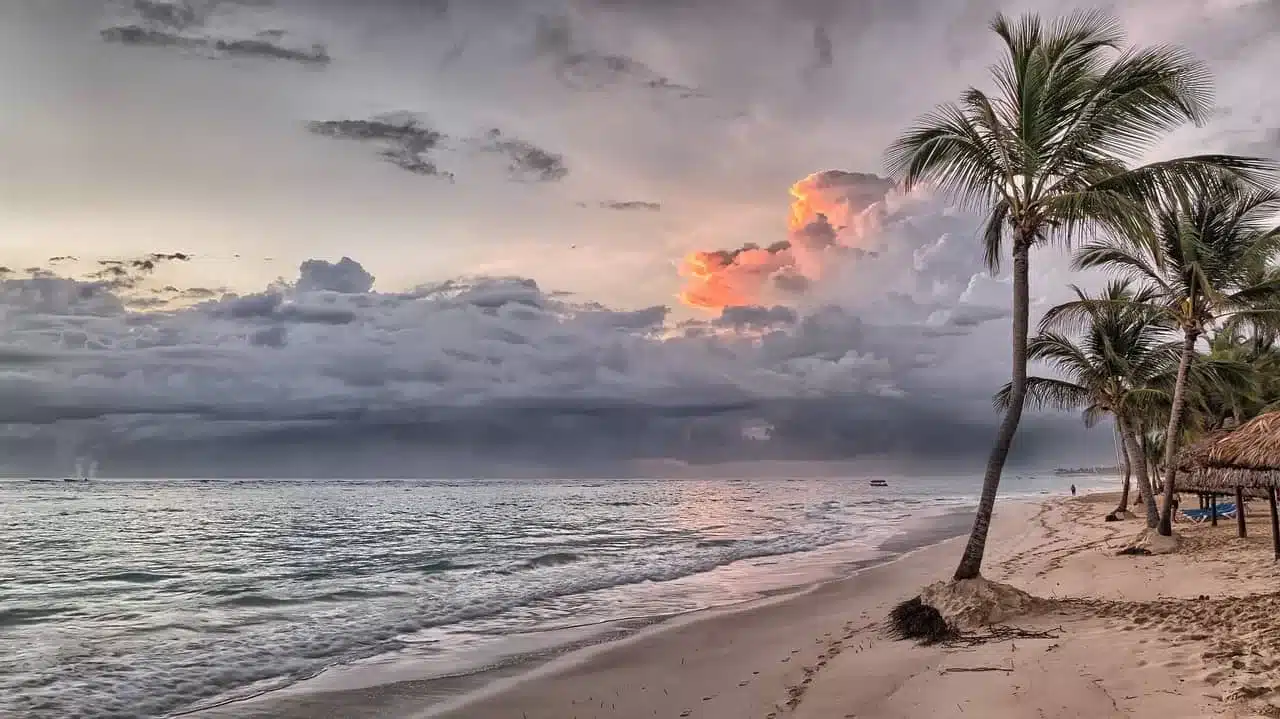
For the past three months, the sea has been boiling, rolling and crashing over the reef, changing color from deep blue to putty-colored green with the churned up sand.

We have only had about a week of fair skies. It is, I am assured by everyone, highly abnormal. An aftermath, perhaps of the giant wave that devoured so many on the other side of the world. We are quite close to a deep sea cavern near Puerto Rico which scientists pinpoint as a perfect location for another Tsunami.

Friends who live on the hill behind town have promised to alert me if they see packs of beach dogs running for safety. The rains have made the streets muddy as only half of them are paved. Everyone is a bit cranky, especially the tourists who are only here for a week or two. Even the locals who keep the guests at the neighboring resort happily playing volleyball and bocce, oiled and massaged, seem a bit depressed.

There is not much to do here without the beach. One can shop at the few stores selling high end jewelry and expensive pareos from Indonesia or dine at one of the thirty restaurants offering the finest in Continental cuisine, albeit at Contenental prices.

Or, if the hotel is high end, flip through the 24 cable channels, Spanish primarily, with four in English, one French, one Italian, one German, testing out how well those audio-lingual courses that you took actually work. It is particularly amusing to watch movies with famous US stars, speaking the dialogue in other voices.

How odd and interesting it was to hear Eddie Murphy and Tom Hanks in Spanish, with completely different voices. But it is the more than 7 miles of coconut palm lined, amber sand beaches that have drawn most of us here.

The town of Las Terrenas on the Samana Peninsula, the northeastern thumb of the Dominican Republic, was only a small fishing village twenty years ago. An influx of foreign ex-pats, mostly French, have produced a boom in Dominican Republic real estate, with the construction of lovely concrete houses and subdivisions.

The local population has grown from 3,000 to 20,000 and the “foreign” population is now estimated around 5,000, predominantly French.  But there is a large Italian complement and many Germans as well, assuring a good supply of garlic and cabbage. English is hardly ever heard. Many of the Europeans are here for the entire winter.

There are fourteen real estate agents in town. Astonishing considering that all purchases must be made completely in cash. Prices have tripled in the last three years and it is hard to find anything for less than $100,000.

Prices in both dining and real estate have not adjusted to the fallen dollar, which was at 50 pesos last year but this year is hovering around 28. I was very lucky to find a beautifully furnished apartment at a long-term rental rate of $400. sI can walk to town along the beach. Electricity here is about twice what it costs in the States, five times what it costs in Europe. My luxurious full sized refrigerator with freezer is quickly identified as a luxury, along with my electric hot-water heater. I have taken to unplugging the heater during the days but the convenience of the freezer, guardian of half of every cooked meal, is a great boon.

I wanted a respectably large nation, not just an island I could circumnavigate in three hours. I wanted a proximity to the States so that my friends, primarily from the East Coast, could afford to visit. And access to the Internet available at a cybercafe. I wanted a place where Americans would be welcomed, something that is getting progressively harder to find.

The Dominican Republic may be one of the few places on earth where they still actually like us. Baseball has, after all been very, very good to them. Remittances sent home by Dominicans in the US are the second largest source of revenues, after the tourist boom. Phone rates from here to the US are the same as a local call, allowing me ample time to visit with my friends. Most of them, shivering through a bleak winter, were hardly sympathetic to my complaints about the rain and storms. Or that I had to scour the town for a sweatshirt to wear for riding on the back of the local transports, the motor scooters known as “conchos” that prowl the streets.

Primarily, I wanted warmth, with year round temperatures that stayed in the 70’s and 80’s. If I never see snow or ice again, I will be content. It will be perhaps a bit brutal here in July and August but certainly no worse than Washington, DC or NYC, as there is always a breeze from the sea. I wanted a friendly sea, in a place that had not been completely paved over and filled with high rises. Yet I did want a bit of tourist destination, with an influx of new energy and a rotating supply of books left behind in the hotels.

I wanted a town rather than a resort strip of all inclusive resort hotels. I had, by Third World standards, a healthy secure retirement income of around $3000 a month which allowed me a large range of choices in Latin America but increasingly fewer options in the West Indies. The blockade of Cuba put it out of the running for a while. I had already lived with the residual racism in the British territories and found it distasteful. Plus, I really wanted to live in “foreign” – i.e., non- English speaking environment. It would take me perhaps years to understand what they were saying. I was unlikely to be bored.

My decision was made when I discovered a French community as my French, after years of study, rivals my English and far exceeds my Spanish. The French, I knew, would have made the place picturesque and would have seen to a good supply of food.

The food in the DR is astonishing by any standards. In the high mountain valley to the west, near Pico Duarte, the tallest mountain in the Caribbean, farmers produce a sumptuous array of produce, citrus and tropical fruits, caulifower, lettuce, green beans and fresh tarragon along with the local assortment of strange and to me, still mysterious root vegetables. The prices for the imports are high. Peanut butter runs around $8 a jar. But the local fishermen ply the beachfront with buckets full of large fresh caught shrimp, mussels, and Dorado. Rice and beans, in a variety of different sauces, along with a small portion of chicken and a salad, the plate known as “The Dominican Flag”, is available for lunch at around $4.00 at the local restuarants. One cannot, however, drink the local tap water and the “touristas’ are not an uncommon ailment, although it does seem that Taino Indians are a little less vengeful than Montezuma.

Here in Las Terrenas, the French have added their bakery, producing baguettes, croissants, and napoleans. The butcher has his own farm, raising the beef, lamb, and chickens sold in his pristine white-tiled shop or the deluxe import-filled supermarket. Camembert and peanut butter, a full variety of imported wines and local beer, line the shelves along with the yogurt, butter and liverwurst that comes to us from Sosua, down the coast to the West.

Many of the “foreigner” are quite young, in their thirties and forties. There is a healthy population both of European and mixed European-Dominican children. It is quite common here to see an older “white” man with his beautiful Dominican girlfriend or wife, usually 20 years or more his junior, often with a full new family of multi-lingual children. Ads in the paper regularly ask for hotel staff who can speak four languages. Unless they own the place, foreigners are unlikely to make more than Dominican salaries, around $100 a week which is hard to live on. Many, however, have savings in dollar based certificates of deposits which yield an astonishing 25%.

Currently there are only 6 “United Staters” living here. The bulk of the English speaking ex-pats have settled to the west, near Puerto Plata. Yet the Samana Penisula is the most spectacularly beautiful area of the DR. Las Terrenas offers a touch of a continental lifestyle along with a frontier edge. So I am certain that more of you will arrive. Won’t you?

Here is probably the most extensive ebook on Everything You Ever Wanted To Know About Eliminating Your Taxes, Protecting Your Assets And Regaining Privacy Over Your Life And Investments. It is called The Ultimate Guide To Going Offshore.  Visit our bookstore to purchase it today!

I hope you enjoyed reading this article: Life In A Dominican Beach Town: An American In The Dominican Republic. If you have any questions, please contact our office HERE.

Enjoy these articles by Escape Artist.

Getting Residency In the Dominican Republic

Ecotourism on a Budget: The Dominican Republic

Dominican Republic

Residency Options in the Dominican Republic


Contact Author

"*" indicates required fields

This field is for validation purposes and should be left unchanged.
Name*
Please let us know what's on your mind. Have a question for us? Ask away.

Stay Ahead on Every Adventure! 

Stay updated with the World News on Escape Artist. Get all the travel news, international destinations, expat living, moving abroad, Lifestyle Tips, and digital nomad opportunities. Your next journey starts here—don’t miss a moment! Subscribe Now!

Life In A Dominican Beach Town: An American In The Dominican Republic

At 6 in the morning, I take my steaming cup of strong Dominican café con leche out to the porch and survey the sea. I have another hour and half before the local commuter traffic, on scooters, quads, pick-ups and buses, starts the parade on the paved beach road in front of the house. It is a wonderful quiet time, as I watch the sea.

(Interested in Dominican Republic? Please see our Dominican Republic real estate listings.)

My awesome appreciation for it is only matched by my daily amazement at the number of times that the mosquitos have bitten me during the night. They are a different sort than in the States, quietier, more laid back, dancing the bachante rather than dive bombing and singing rather sweetly. It is hard to begrudge them a few drops of blood.

For the past three months, the sea has been boiling, rolling and crashing over the reef, changing color from deep blue to putty-colored green with the churned up sand.

We have only had about a week of fair skies. It is, I am assured by everyone, highly abnormal. An aftermath, perhaps of the giant wave that devoured so many on the other side of the world. We are quite close to a deep sea cavern near Puerto Rico which scientists pinpoint as a perfect location for another Tsunami.

Friends who live on the hill behind town have promised to alert me if they see packs of beach dogs running for safety. The rains have made the streets muddy as only half of them are paved. Everyone is a bit cranky, especially the tourists who are only here for a week or two. Even the locals who keep the guests at the neighboring resort happily playing volleyball and bocce, oiled and massaged, seem a bit depressed.

There is not much to do here without the beach. One can shop at the few stores selling high end jewelry and expensive pareos from Indonesia or dine at one of the thirty restaurants offering the finest in Continental cuisine, albeit at Contenental prices.

Or, if the hotel is high end, flip through the 24 cable channels, Spanish primarily, with four in English, one French, one Italian, one German, testing out how well those audio-lingual courses that you took actually work. It is particularly amusing to watch movies with famous US stars, speaking the dialogue in other voices.

How odd and interesting it was to hear Eddie Murphy and Tom Hanks in Spanish, with completely different voices. But it is the more than 7 miles of coconut palm lined, amber sand beaches that have drawn most of us here.

The town of Las Terrenas on the Samana Peninsula, the northeastern thumb of the Dominican Republic, was only a small fishing village twenty years ago. An influx of foreign ex-pats, mostly French, have produced a boom in Dominican Republic real estate, with the construction of lovely concrete houses and subdivisions.

The local population has grown from 3,000 to 20,000 and the “foreign” population is now estimated around 5,000, predominantly French.  But there is a large Italian complement and many Germans as well, assuring a good supply of garlic and cabbage. English is hardly ever heard. Many of the Europeans are here for the entire winter.

There are fourteen real estate agents in town. Astonishing considering that all purchases must be made completely in cash. Prices have tripled in the last three years and it is hard to find anything for less than $100,000.

Prices in both dining and real estate have not adjusted to the fallen dollar, which was at 50 pesos last year but this year is hovering around 28. I was very lucky to find a beautifully furnished apartment at a long-term rental rate of $400. sI can walk to town along the beach. Electricity here is about twice what it costs in the States, five times what it costs in Europe. My luxurious full sized refrigerator with freezer is quickly identified as a luxury, along with my electric hot-water heater. I have taken to unplugging the heater during the days but the convenience of the freezer, guardian of half of every cooked meal, is a great boon.

I wanted a respectably large nation, not just an island I could circumnavigate in three hours. I wanted a proximity to the States so that my friends, primarily from the East Coast, could afford to visit. And access to the Internet available at a cybercafe. I wanted a place where Americans would be welcomed, something that is getting progressively harder to find.

The Dominican Republic may be one of the few places on earth where they still actually like us. Baseball has, after all been very, very good to them. Remittances sent home by Dominicans in the US are the second largest source of revenues, after the tourist boom. Phone rates from here to the US are the same as a local call, allowing me ample time to visit with my friends. Most of them, shivering through a bleak winter, were hardly sympathetic to my complaints about the rain and storms. Or that I had to scour the town for a sweatshirt to wear for riding on the back of the local transports, the motor scooters known as “conchos” that prowl the streets.

Primarily, I wanted warmth, with year round temperatures that stayed in the 70’s and 80’s. If I never see snow or ice again, I will be content. It will be perhaps a bit brutal here in July and August but certainly no worse than Washington, DC or NYC, as there is always a breeze from the sea. I wanted a friendly sea, in a place that had not been completely paved over and filled with high rises. Yet I did want a bit of tourist destination, with an influx of new energy and a rotating supply of books left behind in the hotels.

I wanted a town rather than a resort strip of all inclusive resort hotels. I had, by Third World standards, a healthy secure retirement income of around $3000 a month which allowed me a large range of choices in Latin America but increasingly fewer options in the West Indies. The blockade of Cuba put it out of the running for a while. I had already lived with the residual racism in the British territories and found it distasteful. Plus, I really wanted to live in “foreign” – i.e., non- English speaking environment. It would take me perhaps years to understand what they were saying. I was unlikely to be bored.

My decision was made when I discovered a French community as my French, after years of study, rivals my English and far exceeds my Spanish. The French, I knew, would have made the place picturesque and would have seen to a good supply of food.

The food in the DR is astonishing by any standards. In the high mountain valley to the west, near Pico Duarte, the tallest mountain in the Caribbean, farmers produce a sumptuous array of produce, citrus and tropical fruits, caulifower, lettuce, green beans and fresh tarragon along with the local assortment of strange and to me, still mysterious root vegetables. The prices for the imports are high. Peanut butter runs around $8 a jar. But the local fishermen ply the beachfront with buckets full of large fresh caught shrimp, mussels, and Dorado. Rice and beans, in a variety of different sauces, along with a small portion of chicken and a salad, the plate known as “The Dominican Flag”, is available for lunch at around $4.00 at the local restuarants. One cannot, however, drink the local tap water and the “touristas’ are not an uncommon ailment, although it does seem that Taino Indians are a little less vengeful than Montezuma.

Here in Las Terrenas, the French have added their bakery, producing baguettes, croissants, and napoleans. The butcher has his own farm, raising the beef, lamb, and chickens sold in his pristine white-tiled shop or the deluxe import-filled supermarket. Camembert and peanut butter, a full variety of imported wines and local beer, line the shelves along with the yogurt, butter and liverwurst that comes to us from Sosua, down the coast to the West.

Many of the “foreigner” are quite young, in their thirties and forties. There is a healthy population both of European and mixed European-Dominican children. It is quite common here to see an older “white” man with his beautiful Dominican girlfriend or wife, usually 20 years or more his junior, often with a full new family of multi-lingual children. Ads in the paper regularly ask for hotel staff who can speak four languages. Unless they own the place, foreigners are unlikely to make more than Dominican salaries, around $100 a week which is hard to live on. Many, however, have savings in dollar based certificates of deposits which yield an astonishing 25%.

Currently there are only 6 “United Staters” living here. The bulk of the English speaking ex-pats have settled to the west, near Puerto Plata. Yet the Samana Penisula is the most spectacularly beautiful area of the DR. Las Terrenas offers a touch of a continental lifestyle along with a frontier edge. So I am certain that more of you will arrive. Won’t you?

Here is probably the most extensive ebook on Everything You Ever Wanted To Know About Eliminating Your Taxes, Protecting Your Assets And Regaining Privacy Over Your Life And Investments. It is called The Ultimate Guide To Going Offshore.  Visit our bookstore to purchase it today!

I hope you enjoyed reading this article: Life In A Dominican Beach Town: An American In The Dominican Republic. If you have any questions, please contact our office HERE.

Enjoy these articles by Escape Artist.

Getting Residency In the Dominican Republic

Ecotourism on a Budget: The Dominican Republic

Dominican Republic

Residency Options in the Dominican Republic


Contact Author

"*" indicates required fields

If you'd like to read the full story, simply enter your email to subscribe to our newsletter.

For even more expert insights, unmissable resources, and exclusive invites, explore our premium subscription offers here.

This field is for validation purposes and should be left unchanged.


OR

Subscribe Now

Already a Subscriber? Click here to login

Subscription required

You've reached your limit of free articles. For full access to Escape Artist, and all of our insights on travel, moving abroad, and the digital nomad life, click here to Subscribe.

Already a Subscriber? Log in here
Total
0
Shares
Share 0
Tweet 0
Pin it 0
Related Topics
  • Caribbean
  • cost of living
  • Dominican Republic
  • expat networking
  • learning the language
  • weather and climate
Previous Article
  • Your Plan B

Teak: Frequently Asked Questions Part 2

  • BY Adam McGeehan
  • November 6, 2016
View Post
Next Article
  • Second Citizenship

The easiest way to get a Colombian Visa

  • BY David Steckenreiter
  • February 25, 2017
View Post
You May Also Like
Children touching bananas in the tropical climate of Costa Rica
View Post
  • Costa Rica
Is Costa Rica the Fresh Start Your Family Is Looking For?
  • BY Carla Rodrigues
  • April 27, 2026
Chess pieces on a board overlaid with financial charts and data visualizations representing strategic financial planning
View Post
  • Finance
Building a Resilient Banking Strategy for Life Abroad
  • BY Isha Sesay
  • April 22, 2026
Two students walking across a university campus at sunset, representing international schooling, higher education, and study abroad opportunities.
View Post
  • Second Residency
Raising Global Kids Without Breaking the Bank
  • BY EA Editorial Staff
  • April 22, 2026
Panama City skyline at night with illuminated towers, coastal boulevard, and light trails running along the waterfront
View Post
  • Plan B
Ready to Leave the US? These Countries Might Trump the American Dream
  • BY Emily Draper
  • April 20, 2026
Aerial view of a coastal Portuguese city with hotels, residential buildings, mountains, and the Atlantic shoreline stretching into the distance
View Post
  • Golden Visa
Exploring Currency Considerations for Portugal’s Golden Visa
  • BY Iva Slavtcheva
  • April 15, 2026
Evening street scene in Dubai with illuminated digital billboards, pedestrians, and modern skyscrapers rising in the background
View Post
  • Plan B
Geopolitical Risk and the Shift Beyond the Gulf
  • BY Luigi Wewege
  • April 8, 2026
Two passports including a blue Cuban passport and a Canadian passport held together, representing international travel and dual citizenship documentation
View Post
  • Second Residency
The Ancestral Hedge for a Second Passport
  • BY EA Editorial Staff
  • April 8, 2026
Happy asian family that enjoys beach activities during the summer holidays. parent and children enjoy the sunset sea on beach.Holiday travel concept, Summer vacations.
View Post
  • Relocation
Why Families Are No Longer Raising Children in One Place
  • BY Isha Sesay
  • April 3, 2026
Trending Posts
  • Panama City skyline at night with illuminated towers, coastal boulevard, and light trails running along the waterfront 1
    • Plan B
    Ready to Leave the US? These Countries Might Trump the American Dream
    • April 20, 2026
  • Two people sitting on a beach at sunset with waves rolling in and rocky coastline silhouetted against the golden sky 2
    • Costa Rica
    Why Some Expats Leave Costa Rica (and Others Stay Forever)
    • April 17, 2026
  • Chess pieces on a board overlaid with financial charts and data visualizations representing strategic financial planning 3
    • Finance
    Building a Resilient Banking Strategy for Life Abroad
    • April 22, 2026
  • Aerial view of a coastal Portuguese city with hotels, residential buildings, mountains, and the Atlantic shoreline stretching into the distance 4
    • Golden Visa
    Exploring Currency Considerations for Portugal’s Golden Visa
    • April 15, 2026
  • People enjoying the summer at the beach at Lake Ohrid in North Macedonia 5
    • Europe
    Inside North Macedonia: Europe’s Most Unexpected Reinvention
    • April 24, 2026
Advertise
Know Before You Go
  • Children touching bananas in the tropical climate of Costa Rica 1
    • Costa Rica
    Is Costa Rica the Fresh Start Your Family Is Looking For?
    • April 27, 2026
  • People enjoying the summer at the beach at Lake Ohrid in North Macedonia 2
    • Europe
    Inside North Macedonia: Europe’s Most Unexpected Reinvention
    • April 24, 2026
  • Panama City skyline at night with illuminated towers, coastal boulevard, and light trails running along the waterfront 3
    • Plan B
    Ready to Leave the US? These Countries Might Trump the American Dream
    • April 20, 2026
  • Two people sitting on a beach at sunset with waves rolling in and rocky coastline silhouetted against the golden sky 4
    • Costa Rica
    Why Some Expats Leave Costa Rica (and Others Stay Forever)
    • April 17, 2026
  • Woman walking barefoot along a beach in the Philippines with boats, waterfront buildings, and lush limestone hills in the background 5
    • Digital Nomad
    A Digital Nomad’s Complete Guide to the Philippines
    • April 10, 2026
Learn More
  • About Us
  • Contact
  • Advertise
  • Subscribe
  • Shop
Why Subscribe

The newly imagined Escape Artist brings you fresh content with a global focus, and sharp, up-to-the-minute coverage of the joys, challenges, and opportunities of life abroad.

For a limited time, we’re offering a special discount on all subscription deals, so be sure to lock-in these incredible savings and start receiving top-notch travel and expat content today!

Sign up for the EA Newsletter

Get important news delivered directly to your inbox and stay connected!

This field is for validation purposes and should be left unchanged.
Escape Artist
  • Terms & Conditions
  • Privacy Policy
  • Cookies Policy
  • Disclaimer

Input your search keywords and press Enter.

Escape Artist

The Newsletter for a
Life Beyond Borders

Practical insights and real stories for those building a life abroad, trusted by 75,000 readers worldwide.

This field is for validation purposes and should be left unchanged.

Before you go, want $50 off your Summit registration?

Subscribe, and get $50 discount code for Plan B Summit registration.

Download Your Free Guide

Fill out the form below to get instant access to your guide + receive a $50 discount code for Plan B Summit 2026!

Download Your Free Guide

Fill out the form below to get instant access to your guide + receive a $50 discount code for Plan B Summit 2026!

Download Your Free Guide

Fill out the form below to get instant access to your guide + receive a $50 discount code for Plan B Summit 2026!

Newsletter Subscription