Biculturalism is not the wholesale buying into another culture, nor is it the process of assimilating. I have met expats who by attempting to fully adopt the customs and attitudes of the prevailing culture, even going so far as changing their names, that they became somebody else, to the degree that over time they no longer knew who they were. Overwhelmed by the new culture they suffer a form of the Stockholm syndrome, a loss of personal identity that hostages sometimes experience. What being bicultural means to me, as my friend Abe and mentor pointed out, is the acute ability to both appreciate and also objectively recognize the differences between your passport and host culture, and just as importantly reject those negative elements of both, and all cultures have them. They may be not only unappealing, but also often harmful. Although few achieve it, for me, becoming bicultural is the epitome of the expatriate journey. It is a state of mind, and after you achieve it, you can easily live anywhere and in the process become multi-cultural, while never losing track of who you are. Choosing to make the trip is more of a necessity for an expatriate than it is really a choice if one desires to be happy, but the trek can be both exciting and great fun, and reaching the destination brings with it many fulfilling rewards. Old San Juan still of- fers what it always has and whereas the conquistadors found a sheltered bay on their travels back and forth to the New World, so can expatriates find today in this unique walled city a place that also offers a friendly harbor on their voyage of self-discovery.
People leave their passport country for many reasons, and whereas all expatriates are im- migrants, in my mind, not all immigrants are seeking an expatriate experience. Some are escaping religious and political oppression; others are looking for a better economic life for themselves and their families. These folks often wind up in an ethnic community in their host country with others from their passport country. All cities of any scale have these ghettos, from San Francisco’s China- town, to little Havana in Miami, and little Italy in New York. In Sao Paulo, Brazil, you can hear Japanese spoken in the immigrant neighborhoods, like Liberdade. The United Nations estimated 190 million international migrants in 2005, about 3 percent of global population, and no one knows for sure how many illegal immigrants there are all over the world.
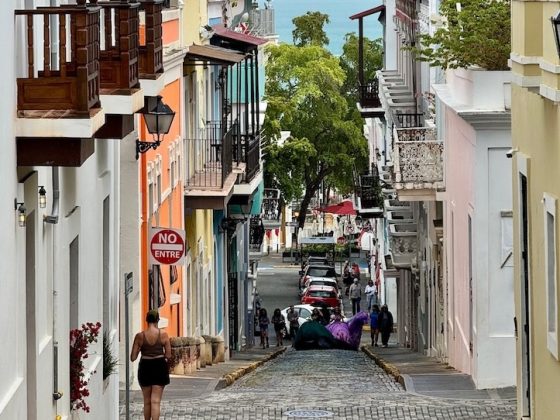
Metropolitan San Juan has some ethnic neighborhoods as well, including West Indian, Dominicans, Haitians, Asian, Middle Eastern, and others, but Old San Juan is almost completely homogenized. There is a wide variety of people, including expats from many countries, and although there is one sector of the old city in which almost all of the homes have gone through restoration, the residents in the city make up a general population of mixed diversity. During the years that I lived In Puerto Rico, I encountered very little ra- cial prejudice compared to the United States, which was refreshing, but there are real class distinctions, meaning rich versus poor, much as there is in most other Latin Ameri- can countries. In addition, among the lower economic groups there are some competition between people of varied national backgrounds, including Latinos such as the Cubans, Dominicans, and Puerto Ricans. Not unlike you may find almost anywhere. Whereas Puerto Ricans view Puerto Rico, more like a country than a state, yet immigration falls under United States federal law. Prior to 911, to travel to any of the island countries in the Caribbean with the exception of Cuba, Americans, Canadians, and many others were only required to have drivers licenses or birth certificates. Today you can not re-enter the United States without a passport after traveling to any of the Caribbean islands with the exception of Puerto Rico and the United States Virgin Islands.
Excerpted and adapted from the ebook “San Juan Antigua (Old San Juan): An Expatriate Life In a Far Off, but Not Too Distant Land” by James L. Tate.
Contact Author
"*" indicates required fields
Stay Ahead on Every Adventure!
Stay updated with the World News on Escape Artist. Get all the travel news, international destinations, expat living, moving abroad, Lifestyle Tips, and digital nomad opportunities. Your next journey starts here—don’t miss a moment! Subscribe Now !
Biculturalism is not the wholesale buying into another culture, nor is it the process of assimilating. I have met expats who by attempting to fully adopt the customs and attitudes of the prevailing culture, even going so far as changing their names, that they became somebody else, to the degree that over time they no longer knew who they were. Overwhelmed by the new culture they suffer a form of the Stockholm syndrome, a loss of personal identity that hostages sometimes experience. What being bicultural means to me, as my friend Abe and mentor pointed out, is the acute ability to both appreciate and also objectively recognize the differences between your passport and host culture, and just as importantly reject those negative elements of both, and all cultures have them. They may be not only unappealing, but also often harmful. Although few achieve it, for me, becoming bicultural is the epitome of the expatriate journey. It is a state of mind, and after you achieve it, you can easily live anywhere and in the process become multi-cultural, while never losing track of who you are. Choosing to make the trip is more of a necessity for an expatriate than it is really a choice if one desires to be happy, but the trek can be both exciting and great fun, and reaching the destination brings with it many fulfilling rewards. Old San Juan still of- fers what it always has and whereas the conquistadors found a sheltered bay on their travels back and forth to the New World, so can expatriates find today in this unique walled city a place that also offers a friendly harbor on their voyage of self-discovery.
People leave their passport country for many reasons, and whereas all expatriates are im- migrants, in my mind, not all immigrants are seeking an expatriate experience. Some are escaping religious and political oppression; others are looking for a better economic life for themselves and their families. These folks often wind up in an ethnic community in their host country with others from their passport country. All cities of any scale have these ghettos, from San Francisco’s China- town, to little Havana in Miami, and little Italy in New York. In Sao Paulo, Brazil, you can hear Japanese spoken in the immigrant neighborhoods, like Liberdade. The United Nations estimated 190 million international migrants in 2005, about 3 percent of global population, and no one knows for sure how many illegal immigrants there are all over the world.
Metropolitan San Juan has some ethnic neighborhoods as well, including West Indian, Dominicans, Haitians, Asian, Middle Eastern, and others, but Old San Juan is almost completely homogenized. There is a wide variety of people, including expats from many countries, and although there is one sector of the old city in which almost all of the homes have gone through restoration, the residents in the city make up a general population of mixed diversity. During the years that I lived In Puerto Rico, I encountered very little ra- cial prejudice compared to the United States, which was refreshing, but there are real class distinctions, meaning rich versus poor, much as there is in most other Latin Ameri- can countries. In addition, among the lower economic groups there are some competition between people of varied national backgrounds, including Latinos such as the Cubans, Dominicans, and Puerto Ricans. Not unlike you may find almost anywhere. Whereas Puerto Ricans view Puerto Rico, more like a country than a state, yet immigration falls under United States federal law. Prior to 911, to travel to any of the island countries in the Caribbean with the exception of Cuba, Americans, Canadians, and many others were only required to have drivers licenses or birth certificates. Today you can not re-enter the United States without a passport after traveling to any of the Caribbean islands with the exception of Puerto Rico and the United States Virgin Islands.
If you'd like to read the full story, simply enter your email to subscribe to our newsletter.
For even more expert insights, unmissable resources, and exclusive invites, explore our premium subscription offers here.
OR
Already a Subscriber? Click here to login
Subscription required
You've reached your limit of free articles. For full access to Escape Artist, and all of our insights on travel, moving abroad, and the digital nomad life, click here to Subscribe.
Already a Subscriber? Log in here